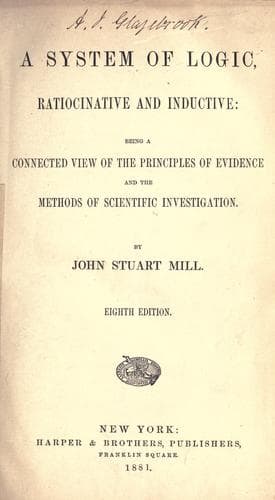
A System of Logic, Ratiocinative and Inductive — John Shaqi
A System of Logic, Ratiocinative and InductiveMill, John Stuart
PhilosophyPhilosophy
A System of Logic, Ratiocinative and Inductive
Mill, John Stuart
Knowledge, Theory of; Logic; Science -- Methodology
It may be objected that the meaning of names can guide us at most only to
the opinions, possibly the foolish and groundless opinions, which mankind
have formed concerning things, and that as the object of philosophy is
truth, not opinion, the philosopher should dismiss words and look into
things themselves, to ascertain what questions can be asked and answered
in regard to them. This advice (which no one has it in his power to
follow) is in reality an exhortation to discard the whole fruits of the
labors of his predecessors, and conduct himself as if he were the first
person who had ever turned an inquiring eye upon nature. What does any
one’s personal knowledge of Things amount to, after subtracting all which
he has acquired by means of the words of other people? Even after he has
learned as much as people usually do learn from others, will the notions
of things contained in his individual mind afford as sufficient a basis
for a _catalogue raisonné_ as the notions which are in the minds of all
mankind?
In any enumeration and classification of Things, which does not set out
from their names, no varieties of things will of course be comprehended
but those recognized by the particular inquirer; and it will still remain
to be established, by a subsequent examination of names, that the
enumeration has omitted nothing which ought to have been included. But if
we begin with names, and use them as our clue to the things, we bring at
once before us all the distinctions which have been recognized, not by a
single inquirer, but by all inquirers taken together. It doubtless may,
and I believe it will, be found, that mankind have multiplied the
varieties unnecessarily, and have imagined distinctions among things,
where there were only distinctions in the manner of naming them. But we
are not entitled to assume this in the commencement. We must begin by
recognizing the distinctions made by ordinary language. If some of these
appear, on a close examination, not to be fundamental, the enumeration of
the different kinds of realities may be abridged accordingly. But to
impose upon the facts in the first instance the yoke of a theory, while
the grounds of the theory are reserved for discussion in a subsequent
stage, is not a course which a logician can reasonably adopt.
Chapter II.
Of Names.
§ 1. “A name,” says Hobbes,(7) “is a word taken at pleasure to serve for a
mark which may raise in our mind a thought like to some thought we had
before, and which being pronounced to others, may be to them a sign of
what thought the speaker had(8) before in his mind.” This simple
definition of a name, as a word (or set of words) serving the double
purpose of a mark to recall to ourselves the likeness of a former thought,
and a sign to make it known to others, appears unexceptionable. Names,
indeed, do much more than this; but whatever else they do, grows out of,
and is the result of this: as will appear in its proper place.
Public-domain text, read in full here on John Shaqi.
Reviews
Reviews
No reviews yet
Be the first to share your thoughts on this work.
Join the Discussion
Join the discussion
Sign in to leave a comment or review.
Sign InorCreate an account