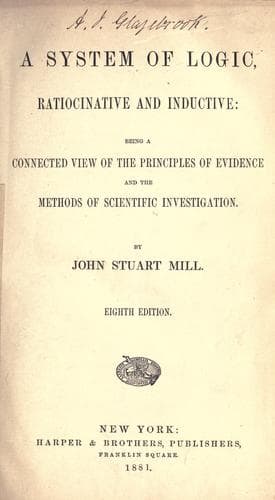
A System of Logic, Ratiocinative and InductiveMill, John Stuart
PhilosophyPhilosophy
A System of Logic, Ratiocinative and Inductive
Mill, John Stuart
Knowledge, Theory of; Logic; Science -- Methodology
Are names more properly said to be the names of things, or of our ideas of
things? The first is the expression in common use; the last is that of
some metaphysicians, who conceived that in adopting it they were
introducing a highly important distinction. The eminent thinker, just
quoted, seems to countenance the latter opinion. “But seeing,” he
continues, “names ordered in speech (as is defined) are signs of our
conceptions, it is manifest they are not signs of the things themselves;
for that the sound of this word _stone_ should be the sign of a stone, can
not be understood in any sense but this, that he that hears it collects
that he that pronounces it thinks of a stone.”
If it be merely meant that the conception alone, and not the thing itself,
is recalled by the name, or imparted to the hearer, this of course can not
be denied. Nevertheless, there seems good reason for adhering to the
common usage, and calling (as indeed Hobbes himself does in other places)
the word _sun_ the name of the sun, and not the name of our idea of the
sun. For names are not intended only to make the hearer conceive what we
conceive, but also to inform him what we believe. Now, when I use a name
for the purpose of expressing a belief, it is a belief concerning the
thing itself, not concerning my idea of it. When I say, “the sun is the
cause of day,” I do not mean that my idea of the sun causes or excites in
me the idea of day; or in other words, that thinking of the sun makes me
think of day. I mean, that a certain physical fact, which is called the
sun’s presence (and which, in the ultimate analysis, resolves itself into
sensations, not ideas) causes another physical fact, which is called day.
It seems proper to consider a word as the _name_ of that which we intend
to be understood by it when we use it; of that which any fact that we
assert of it is to be understood of; that, in short, concerning which,
when we employ the word, we intend to give information. Names, therefore,
shall always be spoken of in this work as the names of things themselves,
and not merely of our ideas of things.
But the question now arises, of what things? and to answer this it is
necessary to take into consideration the different kinds of names.
Public-domain text, read in full here on John Shaqi.
Reviews
Reviews
No reviews yet
Be the first to share your thoughts on this work.
Join the Discussion
Join the discussion
Sign in to leave a comment or review.
Sign InorCreate an account