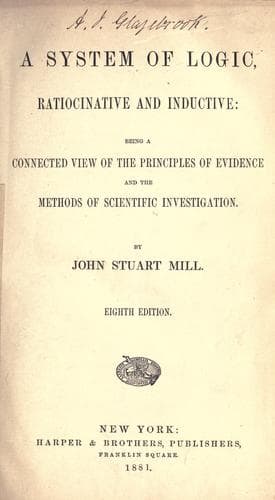
A System of Logic, Ratiocinative and InductiveMill, John Stuart
PhilosophyPhilosophy
A System of Logic, Ratiocinative and Inductive
Mill, John Stuart
Knowledge, Theory of; Logic; Science -- Methodology
Let us now add a second step to the argument: we require, what? Another
assumption? No: the same assumption a second time; and so on to a third,
and a fourth. I confess I do not see how, on Mr. Spencer’s own principles,
the repetition of the assumption at all weakens the force of the argument.
If it were necessary the second time to assume some other axiom, the
argument would no doubt be weakened, since it would be necessary to its
validity that both axioms should be true, and it might happen that one was
true and not the other: making two chances of error instead of one. But
since it is the _same_ axiom, if it is true once it is true every time;
and if the argument, being of a hundred links, assumed the axiom a hundred
times, these hundred assumptions would make but one chance of error among
them all. It is satisfactory that we are not obliged to suppose the
deductions of pure mathematics to be among the most uncertain of
argumentative processes, which on Mr. Spencer’s theory they could hardly
fail to be, since they are the longest. But the number of steps in an
argument does not subtract from its reliableness, if no new _premises_, of
an uncertain character, are taken up by the way.(93)
To speak next of the premises. Our assurance of their truth, whether they
be generalities or individual facts, is grounded, in Mr. Spencer’s
opinion, on the inconceivableness of their being false. It is necessary to
advert to a double meaning of the word inconceivable, which Mr. Spencer is
aware of, and would sincerely disclaim founding an argument upon, but from
which his case derives no little advantage notwithstanding. By
inconceivableness is sometimes meant, inability to form or get rid of an
_idea_; sometimes, inability to form or get rid of a _belief_. The former
meaning is the most conformable to the analogy of language; for a
conception always means an idea, and never a belief. The wrong meaning of
“inconceivable” is, however, fully as frequent in philosophical discussion
as the right meaning, and the intuitive school of metaphysicians could not
well do without either. To illustrate the difference, we will take two
contrasted examples. The early physical speculators considered antipodes
incredible, because inconceivable. But antipodes were not inconceivable in
the primitive sense of the word. An idea of them could be formed without
difficulty: they could be completely pictured to the mental eye. What was
difficult, and, as it then seemed, impossible, was to apprehend them as
believable. The idea could be put together, of men sticking on by their
feet to the under side of the earth; but the belief _would_ follow, that
they must fall off. Antipodes were not unimaginable, but they were
unbelievable.
Public-domain text, read in full here on John Shaqi.
Reviews
Reviews
No reviews yet
Be the first to share your thoughts on this work.
Elsewhere in the archive
Join the Discussion
Join the discussion
Sign in to leave a comment or review.
Sign InorCreate an account