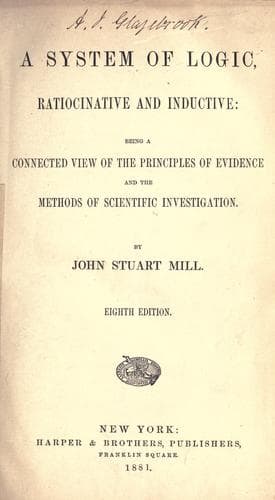
A System of Logic, Ratiocinative and InductiveMill, John Stuart
PhilosophyPhilosophy
A System of Logic, Ratiocinative and Inductive
Mill, John Stuart
Knowledge, Theory of; Logic; Science -- Methodology
On the other hand, when I endeavor to conceive an end to extension, the
two ideas refuse to come together. When I attempt to form a conception of
the last point of space, I can not help figuring to myself a vast space
beyond that last point. The combination is, under the conditions of our
experience, unimaginable. This double meaning of inconceivable it is very
important to bear in mind, for the argument from inconceivableness almost
always turns on the alternate substitution of each of those meanings for
the other.
In which of these two senses does Mr. Spencer employ the term, when he
makes it a test of the truth of a proposition that its negation is
inconceivable? Until Mr. Spencer expressly stated the contrary, I inferred
from the course of his argument, that he meant unbelievable. He has,
however, in a paper published in the fifth number of the _Fortnightly
Review_, disclaimed this meaning, and declared that by an inconceivable
proposition he means, now and always, “one of which the terms can not, by
any effort, be brought before consciousness in that relation which the
proposition asserts between them—a proposition of which the subject and
predicate offer an insurmountable resistance to union in thought.” We now,
therefore, know positively that Mr. Spencer always endeavors to use the
word inconceivable in this, its proper, sense: but it may yet be
questioned whether his endeavor is always successful; whether the other,
and popular use of the word, does not sometimes creep in with its
associations, and prevent him from maintaining a clear separation between
the two. When, for example, he says, that when I feel cold, I can not
conceive that I am not feeling cold, this expression can not be translated
into “I can not conceive myself not feeling cold,” for it is evident that
I can: the word conceive, therefore, is here used to express the
recognition of a matter of fact—the perception of truth or falsehood;
which I apprehend to be exactly the meaning of an act of belief, as
distinguished from simple conception. Again, Mr. Spencer calls the attempt
to conceive something which is inconceivable “an abortive effort to cause
the non-existence,” not of a conception or mental representation, but of a
belief. There is need, therefore, to revise a considerable part of Mr.
Spencer’s language, if it is to be kept always consistent with his
definition of inconceivability. But in truth the point is of little
importance; since inconceivability, in Mr. Spencer’s theory, is only a
test of truth, inasmuch as it is a test of believability. The
inconceivableness of a supposition is the extreme case of its
unbelievability. This is the very foundation of Mr. Spencer’s doctrine.
The invariability of the belief is with him the real guarantee. The
attempt to conceive the negative is made in order to test the
inevitableness of the belief. It should be called, an attempt to _believe_
the negative. When Mr. Spencer says that while looking at the sun a man
Public-domain text, read in full here on John Shaqi.
Reviews
Reviews
No reviews yet
Be the first to share your thoughts on this work.
Elsewhere in the archive
Join the Discussion
Join the discussion
Sign in to leave a comment or review.
Sign InorCreate an account