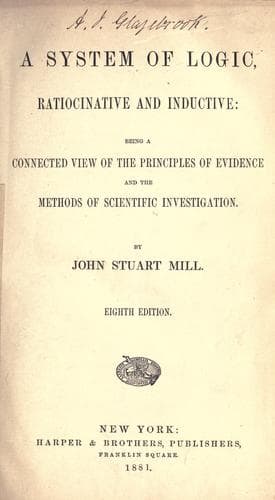
A System of Logic, Ratiocinative and InductiveMill, John Stuart
PhilosophyPhilosophy
A System of Logic, Ratiocinative and Inductive
Mill, John Stuart
Knowledge, Theory of; Logic; Science -- Methodology
can not conceive that he is looking into darkness, he should have said
that a man can not _believe_ that he is doing so. For it is surely
possible, in broad daylight, to _imagine_ one’s self looking into
darkness.(94) As Mr. Spencer himself says, speaking of the belief of our
own existence, “That he _might_ not exist, he can conceive well enough;
but that he _does_ not exist, he finds it impossible to conceive,” _i.e._,
to believe. So that the statement resolves itself into this: That I exist,
and that I have sensations, I believe, because I can not believe
otherwise. And in this case every one will admit that the impossibility is
real. Any one’s present sensations, or other states of subjective
consciousness, that one person inevitably believes. They are facts known
_per se_: it is impossible to ascend beyond them. Their negative is really
unbelievable, and therefore there is never any question about believing
it. Mr. Spencer’s theory is not needed for these truths.
But according to Mr. Spencer there are other beliefs, relating to other
things than our own subjective feelings, for which we have the same
guarantee—which are, in a similar manner, invariable and necessary. With
regard to these other beliefs, they can not be necessary, since they do
not always exist. There have been, and are, many persons who do not
believe the reality of an external world, still less the reality of
extension and figure as the forms of that external world; who do not
believe that space and time have an existence independent of the mind—nor
any other of Mr. Spencer’s objective intuitions. The negations of these
alleged invariable beliefs are not unbelievable, for they are believed. It
may be maintained, without obvious error, that we can not _imagine_
tangible objects as mere states of our own and other people’s
consciousness; that the perception of them irresistibly suggests to us the
_idea_ of something external to ourselves: and I am not in a condition to
say that this is not the fact (though I do not think any one is entitled
to affirm it of any person besides himself). But many thinkers have
believed, whether they could conceive it or not, that what we represent to
ourselves as material objects, are mere modifications of consciousness;
complex feelings of touch and of muscular action. Mr. Spencer may think
the inference correct from the unimaginable to the unbelievable, because
he holds that belief itself is but the persistence of an idea, and that
what we can succeed in imagining we can not at the moment help
apprehending as believable. But of what consequence is it what we
apprehend at the moment, if the moment is in contradiction to the
permanent state of our mind? A person who has been frightened when an
infant by stories of ghosts, though he disbelieves them in after years
(and perhaps never believed them), may be unable all his life to be in a
dark place, in circumstances stimulating to the imagination, without
mental discomposure.
Public-domain text, read in full here on John Shaqi.
Reviews
Reviews
No reviews yet
Be the first to share your thoughts on this work.
Elsewhere in the archive
Join the Discussion
Join the discussion
Sign in to leave a comment or review.
Sign InorCreate an account