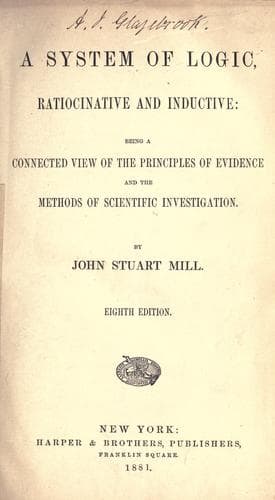
A System of Logic, Ratiocinative and InductiveMill, John Stuart
PhilosophyPhilosophy
A System of Logic, Ratiocinative and Inductive
Mill, John Stuart
Knowledge, Theory of; Logic; Science -- Methodology
The idea of ghosts, with all its attendant terrors,
is irresistibly called up in his mind by the outward circumstances. Mr.
Spencer may say, that while he is under the influence of this terror he
does not disbelieve in ghosts, but has a temporary and uncontrollable
belief in them. Be it so; but allowing it to be so, which would it be
truest to say of this man on the whole—that he believes in ghosts, or that
he does not believe in them? Assuredly that he does not believe in them.
The case is similar with those who disbelieve a material world. Though
they can not get rid of the idea; though while looking at a solid object
they can not help having the conception, and therefore, according to Mr.
Spencer’s metaphysics, the momentary belief, of its externality; even at
that moment they would sincerely deny holding that belief: and it would be
incorrect to call them other than disbelievers of the doctrine. The belief
therefore is not invariable; and the test of inconceivableness fails in
the only cases to which there could ever be any occasion to apply it.
That a thing may be perfectly believable, and yet may not have become
conceivable, and that we may habitually believe one side of an
alternative, and conceive only in the other, is familiarly exemplified in
the state of mind of educated persons respecting sunrise and sunset. All
educated persons either know by investigation, or believe on the authority
of science, that it is the earth and not the sun which moves: but there
are probably few who habitually _conceive_ the phenomenon otherwise than
as the ascent or descent of the sun. Assuredly no one can do so without a
prolonged trial; and it is probably not easier now than in the first
generation after Copernicus. Mr. Spencer does not say, “In looking at
sunrise it is impossible not to conceive that it is the sun which moves,
therefore this is what every body believes, and we have all the evidence
for it that we can have for any truth.” Yet this would be an exact
parallel to his doctrine about the belief in matter.
The existence of matter, and other Noumena, as distinguished from the
phenomenal world, remains a question of argument, as it was before; and
the very general, but neither necessary nor universal, belief in them,
stands as a psychological phenomenon to be explained, either on the
hypothesis of its truth, or on some other. The belief is not a conclusive
proof of its own truth, unless there are no such things as _idola tribûs_;
but being a fact, it calls on antagonists to show, from what except the
real existence of the thing believed, so general and apparently
spontaneous a belief can have originated. And its opponents have never
hesitated to accept this challenge.(95) The amount of their success in
meeting it will probably determine the ultimate verdict of philosophers on
the question.
Public-domain text, read in full here on John Shaqi.
Reviews
Reviews
No reviews yet
Be the first to share your thoughts on this work.
Elsewhere in the archive
Join the Discussion
Join the discussion
Sign in to leave a comment or review.
Sign InorCreate an account