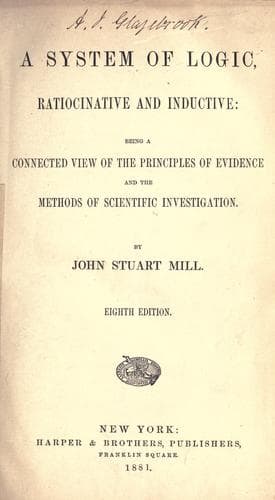
A System of Logic, Ratiocinative and InductiveMill, John Stuart
PhilosophyPhilosophy
A System of Logic, Ratiocinative and Inductive
Mill, John Stuart
Knowledge, Theory of; Logic; Science -- Methodology
§ 4. In the revision, or rather reconstruction, of his “Principles of
Psychology,” as one of the stages or platforms in the imposing structure
of his System of Philosophy, Mr. Spencer has resumed what he justly
terms(96) the “amicable controversy that has been long pending between
us;” expressing at the same time a regret, which I cordially share, that
“this lengthened exposition of a single point of difference, unaccompanied
by an exposition of the numerous points of concurrence, unavoidably
produces an appearance of dissent very far greater than that which
exists.” I believe, with Mr. Spencer, that the difference between us, if
measured by our conclusions, is “superficial rather than substantial;” and
the value I attach to so great an amount of agreement, in the field of
analytic psychology, with a thinker of his force and depth, is such as I
can hardly overstate. But I also agree with him that the difference which
exists in our premises is one of “profound importance, philosophically
considered;” and not to be dismissed while any part of the case of either
of us has not been fully examined and discussed.
In his present statement of the Universal Postulate, Mr. Spencer has
exchanged his former expression, “beliefs which invariably exist,” for the
following: “cognitions of which the predicates invariably exist along with
their subjects.” And he says that “an abortive effort to conceive the
negation of a proposition, shows that the cognition expressed is one of
which the predicate invariably exists along with its subject; and the
discovery that the predicate invariably exists along with its subject, is
the discovery that this cognition is one we are compelled to accept.” Both
these premises of Mr. Spencer’s syllogism I am able to assent to, but in
different senses of the middle term. If the invariable existence of the
predicate along with its subject, is to be understood in the most obvious
meaning, as an existence in actual Nature, or in other words, in our
objective, or sensational, experience, I of course admit that this, once
ascertained, compels us to accept the proposition: but then I do not admit
that the failure of an attempt to conceive the negative, proves the
predicate to be always co-existent with the subject in actual Nature. If,
on the other hand (which I believe to be Mr. Spencer’s meaning) the
invariable existence of the predicate along with the subject is to be
understood only of our conceptive faculty, _i.e._, that the one is
inseparable from the other in our thoughts; then, indeed, the inability to
separate the two ideas proves their inseparable conjunction, here and now,
in the mind which has failed in the attempt; but this inseparability in
thought does not prove a corresponding inseparability in fact; nor even in
the thoughts of other people, or of the same person in a possible future.
Public-domain text, read in full here on John Shaqi.
Reviews
Reviews
No reviews yet
Be the first to share your thoughts on this work.
Elsewhere in the archive
Join the Discussion
Join the discussion
Sign in to leave a comment or review.
Sign InorCreate an account