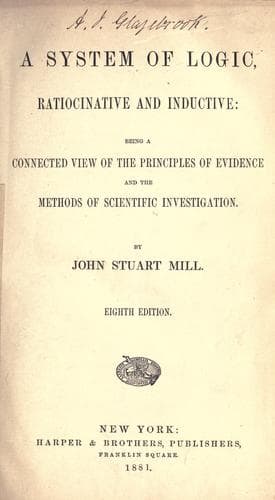
A System of Logic, Ratiocinative and InductiveMill, John Stuart
PhilosophyPhilosophy
A System of Logic, Ratiocinative and Inductive
Mill, John Stuart
Knowledge, Theory of; Logic; Science -- Methodology
§ 3. All names are names of something, real or imaginary; but all things
have not names appropriated to them individually. For some individual
objects we require, and consequently have, separate distinguishing names;
there is a name for every person, and for every remarkable place. Other
objects, of which we have not occasion to speak so frequently, we do not
designate by a name of their own; but when the necessity arises for naming
them, we do so by putting together several words, each of which, by
itself, might be and is used for an indefinite number of other objects; as
when I say, _this stone_: “this” and “stone” being, each of them, names
that may be used of many other objects besides the particular one meant,
though the only object of which they can both be used at the given moment,
consistently with their signification, may be the one of which I wish to
speak.
Were this the sole purpose for which names, that are common to more things
than one, could be employed; if they only served, by mutually limiting
each other, to afford a designation for such individual objects as have no
names of their own: they could only be ranked among contrivances for
economizing the use of language. But it is evident that this is not their
sole function. It is by their means that we are enabled to assert
_general_ propositions; to affirm or deny any predicate of an indefinite
number of things at once. The distinction, therefore, between _general_
names, and _individual_ or _singular_ names, is fundamental; and may be
considered as the first grand division of names.
A general name is familiarly defined, a name which is capable of being
truly affirmed, in the same sense, of each of an indefinite number of
things. An individual or singular name is a name which is only capable of
being truly affirmed, in the same sense, of one thing.
Thus, _man_ is capable of being truly affirmed of John, George, Mary, and
other persons without assignable limit; and it is affirmed of all of them
in the same sense; for the word man expresses certain qualities, and when
we predicate it of those persons, we assert that they all possess those
qualities. But _John_ is only capable of being truly affirmed of one
single person, at least in the same sense. For, though there are many
persons who bear that name, it is not conferred upon them to indicate any
qualities, or any thing which belongs to them in common; and can not be
said to be affirmed of them in any _sense_ at all, consequently not in the
same sense. “The king who succeeded William the Conqueror,” is also an
individual name. For, that there can not be more than one person of whom
it can be truly affirmed, is implied in the meaning of the words. Even
“_the_ king,” when the occasion or the context defines the individual of
whom it is to be understood, may justly be regarded as an individual name.
Public-domain text, read in full here on John Shaqi.
Reviews
Reviews
No reviews yet
Be the first to share your thoughts on this work.
Join the Discussion
Join the discussion
Sign in to leave a comment or review.
Sign InorCreate an account