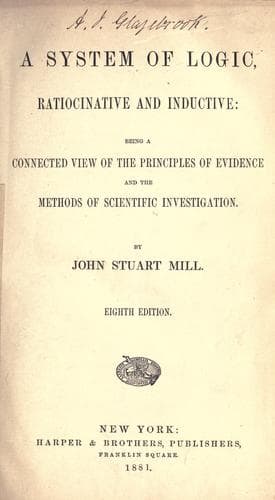
A System of Logic, Ratiocinative and InductiveMill, John Stuart
PhilosophyPhilosophy
A System of Logic, Ratiocinative and Inductive
Mill, John Stuart
Knowledge, Theory of; Logic; Science -- Methodology
Words which are not capable of being used as names, but only as parts of
names, were called by some of the schoolmen Syncategorematic terms: from
σὺν, with, and κατηγορέω, to predicate, because it was only _with_ some
other word that they could be predicated. A word which could be used
either as the subject or predicate of a proposition without being
accompanied by any other word, was termed by the same authorities a
Categorematic term. A combination of one or more Categorematic, and one or
more Syncategorematic words, as A heavy body, or A court of justice, they
sometimes called a _mixed_ term; but this seems a needless multiplication
of technical expressions. A mixed term is, in the only useful sense of the
word, Categorematic. It belongs to the class of what have been called
many-worded names.
For, as one word is frequently not a name, but only part of a name, so a
number of words often compose one single name, and no more. These words,
“The place which the wisdom or policy of antiquity had destined for the
residence of the Abyssinian princes,” form in the estimation of the
logician only one name; one Categorematic term. A mode of determining
whether any set of words makes only one name, or more than one, is by
predicating something of it, and observing whether, by this predication,
we make only one assertion or several. Thus, when we say, John Nokes, who
was the mayor of the town, died yesterday—by this predication we make but
one assertion; whence it appears that “John Nokes, who was the mayor of
the town,” is no more than one name. It is true that in this proposition,
besides the assertion that John Nokes died yesterday, there is included
another assertion, namely, that John Nokes was mayor of the town. But this
last assertion was already made: we did not make it by adding the
predicate, “died yesterday.” Suppose, however, that the words had been,
John Nokes _and_ the mayor of the town, they would have formed two names
instead of one. For when we say, John Nokes and the mayor of the town died
yesterday, we make two assertions: one, that John Nokes died yesterday;
the other, that the mayor of the town died yesterday.
It being needless to illustrate at any greater length the subject of
many-worded names, we proceed to the distinctions which have been
established among names, not according to the words they are composed of,
but according to their signification.
Public-domain text, read in full here on John Shaqi.
Reviews
Reviews
No reviews yet
Be the first to share your thoughts on this work.
Join the Discussion
Join the discussion
Sign in to leave a comment or review.
Sign InorCreate an account