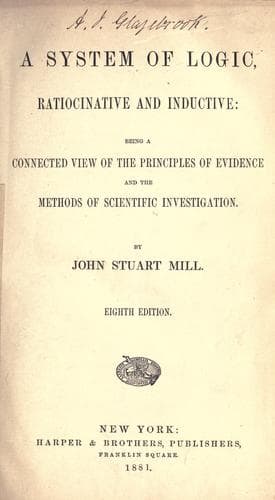
A System of Logic, Ratiocinative and InductiveMill, John Stuart
PhilosophyPhilosophy
A System of Logic, Ratiocinative and Inductive
Mill, John Stuart
Knowledge, Theory of; Logic; Science -- Methodology
To cement together the detached fragments of a subject, never yet treated
as a whole; to harmonize the true portions of discordant theories, by
supplying the links of thought necessary to connect them, and by
disentangling them from the errors with which they are always more or less
interwoven, must necessarily require a considerable amount of original
speculation. To other originality than this, the present work lays no
claim. In the existing state of the cultivation of the sciences, there
would be a very strong presumption against any one who should imagine that
he had effected a revolution in the theory of the investigation of truth,
or added any fundamentally new process to the practice of it. The
improvement which remains to be effected in the methods of philosophizing
(and the author believes that they have much need of improvement) can only
consist in performing more systematically and accurately operations with
which, at least in their elementary form, the human intellect, in some one
or other of its employments, is already familiar.
In the portion of the work which treats of Ratiocination, the author has
not deemed it necessary to enter into technical details which may be
obtained in so perfect a shape from the existing treatises on what is
termed the Logic of the Schools. In the contempt entertained by many
modern philosophers for the syllogistic art, it will be seen that he by no
means participates; though the scientific theory on which its defense is
usually rested appears to him erroneous: and the view which he has
suggested of the nature and functions of the Syllogism may, perhaps,
afford the means of conciliating the principles of the art with as much as
is well grounded in the doctrines and objections of its assailants.
The same abstinence from details could not be observed in the First Book,
on Names and Propositions; because many useful principles and distinctions
which were contained in the old Logic have been gradually omitted from the
writings of its later teachers; and it appeared desirable both to revive
these, and to reform and rationalize the philosophical foundation on which
they stood. The earlier chapters of this preliminary Book will
consequently appear, to some readers, needlessly elementary and
scholastic. But those who know in what darkness the nature of our
knowledge, and of the processes by which it is obtained, is often involved
by a confused apprehension of the import of the different classes of Words
and Assertions, will not regard these discussions as either frivolous, or
irrelevant to the topics considered in the later Books.
Public-domain text, read in full here on John Shaqi.
Reviews
Reviews
No reviews yet
Be the first to share your thoughts on this work.
Join the Discussion
Join the discussion
Sign in to leave a comment or review.
Sign InorCreate an account