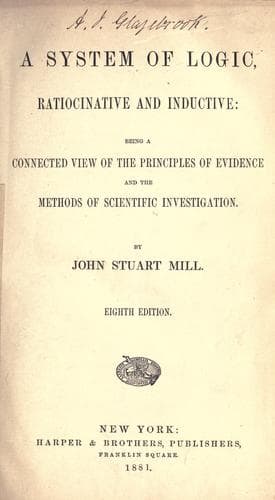
A System of Logic, Ratiocinative and InductiveMill, John Stuart
PhilosophyPhilosophy
A System of Logic, Ratiocinative and Inductive
Mill, John Stuart
Knowledge, Theory of; Logic; Science -- Methodology
On the subject of Induction, the task to be performed was that of
generalizing the modes of investigating truth and estimating evidence, by
which so many important and recondite laws of nature have, in the various
sciences, been aggregated to the stock of human knowledge. That this is
not a task free from difficulty may be presumed from the fact that even at
a very recent period, eminent writers (among whom it is sufficient to name
Archbishop Whately, and the author of a celebrated article on Bacon in the
_Edinburgh Review_) have not scrupled to pronounce it impossible.(1) The
author has endeavored to combat their theory in the manner in which
Diogenes confuted the skeptical reasonings against the possibility of
motion; remembering that Diogenes’s argument would have been equally
conclusive, though his individual perambulations might not have extended
beyond the circuit of his own tub.
Whatever may be the value of what the author has succeeded in effecting on
this branch of his subject, it is a duty to acknowledge that for much of
it he has been indebted to several important treatises, partly historical
and partly philosophical, on the generalities and processes of physical
science, which have been published within the last few years. To these
treatises, and to their authors, he has endeavored to do justice in the
body of the work. But as with one of these writers, Dr. Whewell, he has
occasion frequently to express differences of opinion, it is more
particularly incumbent on him in this place to declare, that without the
aid derived from the facts and ideas contained in that gentleman’s
“History of the Inductive Sciences,” the corresponding portion of this
work would probably not have been written.
The concluding Book is an attempt to contribute toward the solution of a
question which the decay of old opinions, and the agitation that disturbs
European society to its inmost depths, render as important in the present
day to the practical interests of human life, as it must at all times be
to the completeness of our speculative knowledge—viz.: Whether moral and
social phenomena are really exceptions to the general certainty and
uniformity of the course of nature; and how far the methods by which so
many of the laws of the physical world have been numbered among truths
irrevocably acquired and universally assented to, can be made instrumental
to the formation of a similar body of received doctrine in moral and
political science.
PREFACE TO THE THIRD AND FOURTH EDITIONS.
Several criticisms, of a more or less controversial character, on this
work, have appeared since the publication of the second edition; and Dr.
Whewell has lately published a reply to those parts of it in which some of
his opinions were controverted.(2)
Public-domain text, read in full here on John Shaqi.
Reviews
Reviews
No reviews yet
Be the first to share your thoughts on this work.
Join the Discussion
Join the discussion
Sign in to leave a comment or review.
Sign InorCreate an account