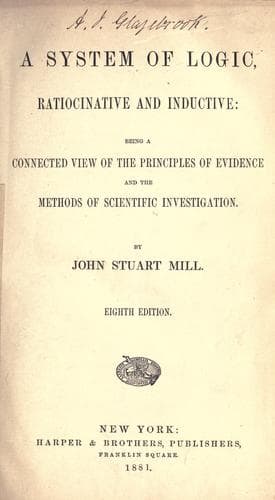
A System of Logic, Ratiocinative and InductiveMill, John Stuart
PhilosophyPhilosophy
A System of Logic, Ratiocinative and Inductive
Mill, John Stuart
Knowledge, Theory of; Logic; Science -- Methodology
Proper names are not connotative: they denote the individuals who are
called by them; but they do not indicate or imply any attributes as
belonging to those individuals. When we name a child by the name Paul, or
a dog by the name Cæsar, these names are simply marks used to enable those
individuals to be made subjects of discourse. It may be said, indeed, that
we must have had some reason for giving them those names rather than any
others; and this is true; but the name, once given, is independent of the
reason. A man may have been named John, because that was the name of his
father; a town may have been named Dartmouth, because it is situated at
the mouth of the Dart. But it is no part of the signification of the word
John, that the father of the person so called bore the same name; nor even
of the word Dartmouth, to be situated at the mouth of the Dart. If sand
should choke up the mouth of the river, or an earthquake change its
course, and remove it to a distance from the town, the name of the town
would not necessarily be changed. That fact, therefore, can form no part
of the signification of the word; for otherwise, when the fact confessedly
ceased to be true, no one would any longer think of applying the name.
Proper names are attached to the objects themselves, and are not dependent
on the continuance of any attribute of the object.
But there is another kind of names, which, although they are individual
names—that is, predicable only of one object—are really connotative. For,
though we may give to an individual a name utterly unmeaning, which we
call a proper name—a word which answers the purpose of showing what thing
it is we are talking about, but not of telling any thing about it; yet a
name peculiar to an individual is not necessarily of this description. It
may be significant of some attribute, or some union of attributes, which,
being possessed by no object but one, determines the name exclusively to
that individual. “The sun” is a name of this description; “God,” when used
by a monotheist, is another. These, however, are scarcely examples of what
we are now attempting to illustrate, being, in strictness of language,
general, not individual names: for, however they may be _in fact_
predicable only of one object, there is nothing in the meaning of the
words themselves which implies this: and, accordingly, when we are
imagining and not affirming, we may speak of many suns; and the majority
of mankind have believed, and still believe, that there are many gods. But
it is easy to produce words which are real instances of connotative
individual names. It may be part of the meaning of the connotative name
itself, that there can exist but one individual possessing the attribute
which it connotes: as, for instance, “the _only_ son of John Stiles;” “the
_first_ emperor of Rome.” Or the attribute connoted may be a connection
with some determinate event, and the connection may be of such a kind as
Public-domain text, read in full here on John Shaqi.
Reviews
Reviews
No reviews yet
Be the first to share your thoughts on this work.
Join the Discussion
Join the discussion
Sign in to leave a comment or review.
Sign InorCreate an account