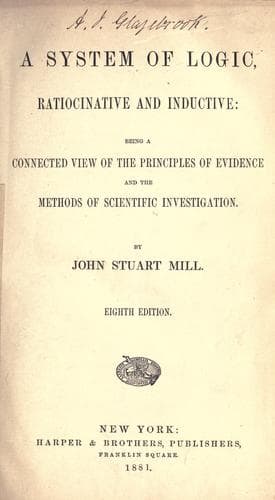
A System of Logic, Ratiocinative and Inductive — John Shaqi
A System of Logic, Ratiocinative and InductiveMill, John Stuart
PhilosophyPhilosophy
A System of Logic, Ratiocinative and Inductive
Mill, John Stuart
Knowledge, Theory of; Logic; Science -- Methodology
only one individual could have; or may at least be such as only one
individual actually had; and this may be implied in the form of the
expression. “The father of Socrates” is an example of the one kind (since
Socrates could not have had two fathers); “the author of the Iliad,” “the
murderer of Henri Quatre,” of the second. For, though it is conceivable
that more persons than one might have participated in the authorship of
the Iliad, or in the murder of Henri Quatre, the employment of the article
_the_ implies that, in fact, this was not the case. What is here done by
the word _the_, is done in other cases by the context: thus, “Cæsar’s
army” is an individual name, if it appears from the context that the army
meant is that which Cæsar commanded in a particular battle. The still more
general expressions, “the Roman army,” or “the Christian army,” may be
individualized in a similar manner. Another case of frequent occurrence
has already been noticed; it is the following: The name, being a
many-worded one, may consist, in the first place, of a _general_ name,
capable therefore in itself of being affirmed of more things than one, but
which is, in the second place, so limited by other words joined with it,
that the entire expression can only be predicated of one object,
consistently with the meaning of the general term. This is exemplified in
such an instance as the following: “the present prime minister of
England.” Prime Minister of England is a general name; the attributes
which it connotes may be possessed by an indefinite number of persons: in
succession however, not simultaneously; since the meaning of the name
itself imports (among other things) that there can be only one such person
at a time. This being the case, and the application of the name being
afterward limited by the article and the word _present_, to such
individuals as possess the attributes at one indivisible point of time, it
becomes applicable only to one individual. And as this appears from the
meaning of the name, without any extrinsic proof, it is strictly an
individual name.
From the preceding observations it will easily be collected, that whenever
the names given to objects convey any information—that is, whenever they
have properly any meaning—the meaning resides not in what they _denote_,
but in what they _connote_. The only names of objects which connote
nothing are _proper_ names; and these have, strictly speaking, no
signification.(12)
Public-domain text, read in full here on John Shaqi.
Reviews
Reviews
No reviews yet
Be the first to share your thoughts on this work.
Join the Discussion
Join the discussion
Sign in to leave a comment or review.
Sign InorCreate an account