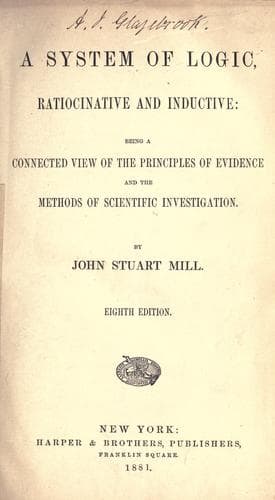
A System of Logic, Ratiocinative and InductiveMill, John Stuart
PhilosophyPhilosophy
A System of Logic, Ratiocinative and Inductive
Mill, John Stuart
Knowledge, Theory of; Logic; Science -- Methodology
Names with indeterminate connotation are not to be confounded with names
which have more than one connotation, that is to say, ambiguous words. A
word may have several meanings, but all of them fixed and recognized ones;
as the word _post_, for example, or the word _box_, the various senses of
which it would be endless to enumerate. And the paucity of existing names,
in comparison with the demand for them, may often render it advisable and
even necessary to retain a name in this multiplicity of acceptations,
distinguishing these so clearly as to prevent their being confounded with
one another. Such a word may be considered as two or more names,
accidentally written and spoken alike.(14)
§ 6. The fourth principal division of names, is into _positive_ and
_negative_. Positive, as _man_, _tree_, _good_; negative, as _not-man_,
_not-tree_, _not-good_. To every positive concrete name, a corresponding
negative one might be framed. After giving a name to any one thing, or to
any plurality of things, we might create a second name which should be a
name of all things whatever, except that particular thing or things. These
negative names are employed whenever we have occasion to speak
collectively of all things other than some thing or class of things. When
the positive name is connotative, the corresponding negative name is
connotative likewise; but in a peculiar way, connoting not the presence
but the absence of an attribute. Thus, _not-white_ denotes all things
whatever except white things; and connotes the attribute of not possessing
whiteness. For the non-possession of any given attribute is also an
attribute, and may receive a name as such; and thus negative concrete
names may obtain negative abstract names to correspond to them.(15)
Names which are positive in form are often negative in reality, and others
are really positive though their form is negative. The word
_inconvenient_, for example, does not express the mere absence of
convenience; it expresses a positive attribute—that of being the cause of
discomfort or annoyance. So the word _unpleasant_, notwithstanding its
negative form, does not connote the mere absence of pleasantness, but a
less degree of what is signified by the word _painful_, which, it is
hardly necessary to say, is positive. _Idle_, on the other hand, is a word
which, though positive in form, expresses nothing but what would be
signified either by the phrase _not working_, or by the phrase _not
disposed to work_; and _sober_, either by _not drunk_ or by _not drunken_.
Public-domain text, read in full here on John Shaqi.
Reviews
Reviews
No reviews yet
Be the first to share your thoughts on this work.
Join the Discussion
Join the discussion
Sign in to leave a comment or review.
Sign InorCreate an account