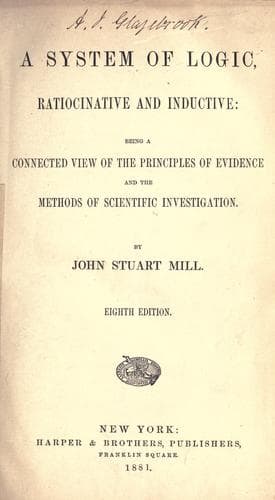
A System of Logic, Ratiocinative and InductiveMill, John Stuart
PhilosophyPhilosophy
A System of Logic, Ratiocinative and Inductive
Mill, John Stuart
Knowledge, Theory of; Logic; Science -- Methodology
There is a class of names called _privative_. A privative name is
equivalent in its signification to a positive and a negative name taken
together; being the name of something which has once had a particular
attribute, or for some other reason might have been expected to have it,
but which has it not. Such is the word _blind_, which is not equivalent to
_not seeing_, or to _not capable of seeing_, for it would not, except by a
poetical or rhetorical figure, be applied to stocks and stones. A thing is
not usually said to be blind, unless the class to which it is most
familiarly referred, or to which it is referred on the particular
occasion, be chiefly composed of things which can see, as in the case of a
blind man, or a blind horse; or unless it is supposed for any reason that
it ought to see; as in saying of a man, that he rushed blindly into an
abyss, or of philosophers or the clergy that the greater part of them are
blind guides. The names called privative, therefore, connote two things;
the absence of certain attributes, and the presence of others, from which
the presence also of the former might naturally have been expected.
§ 7. The fifth leading division of names is into _relative_ and
_absolute_, or let us rather say, _relative_ and _non-relative_; for the
word absolute is put upon much too hard duty in metaphysics, not to be
willingly spared when its services can be dispensed with. It resembles the
word _civil_ in the language of jurisprudence, which stands for the
opposite of criminal, the opposite of ecclesiastical, the opposite of
military, the opposite of political—in short, the opposite of any positive
word which wants a negative.
Relative names are such as father, son; ruler, subject; like; equal;
unlike; unequal; longer, shorter; cause, effect. Their characteristic
property is, that they are always given in pairs. Every relative name
which is predicated of an object, supposes another object (or objects), of
which we may predicate either that same name or another relative name
which is said to be the _correlative_ of the former. Thus, when we call
any person a son, we suppose other persons who must be called parents.
When we call any event a cause, we suppose another event which is an
effect. When we say of any distance that it is longer, we suppose another
distance which is shorter. When we say of any object that it is like, we
mean that it is like some other object, which is also said to be like the
first. In this last case both objects receive the same name; the relative
term is its own correlative.
Public-domain text, read in full here on John Shaqi.
Reviews
Reviews
No reviews yet
Be the first to share your thoughts on this work.
Join the Discussion
Join the discussion
Sign in to leave a comment or review.
Sign InorCreate an account