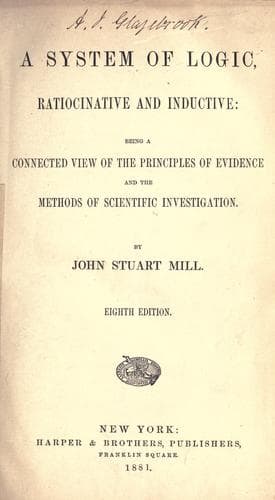
A System of Logic, Ratiocinative and InductiveMill, John Stuart
PhilosophyPhilosophy
A System of Logic, Ratiocinative and Inductive
Mill, John Stuart
Knowledge, Theory of; Logic; Science -- Methodology
In this manner any fact, or series of facts, in which two different
objects are implicated, and which is therefore predicable of both of them,
may be either considered as constituting an attribute of the one, or an
attribute of the other. According as we consider it in the former, or in
the latter aspect, it is connoted by the one or the other of the two
correlative names. _Father_ connotes the fact, regarded as constituting an
attribute of A; _son_ connotes the same fact, as constituting an attribute
of B. It may evidently be regarded with equal propriety in either light.
And all that appears necessary to account for the existence of relative
names, is, that whenever there is a fact in which two individuals are
concerned, an attribute grounded on that fact may be ascribed to either of
these individuals.
A name, therefore, is said to be relative, when, over and above the object
which it denotes, it implies in its signification the existence of another
object, also deriving a denomination from the same fact which is the
ground of the first name. Or (to express the same meaning in other words)
a name is relative, when, being the name of one thing, its signification
can not be explained but by mentioning another. Or we may state it
thus—when the name can not be employed in discourse so as to have a
meaning, unless the name of some other thing than what it is itself the
name of, be either expressed or understood. These definitions are all, at
bottom, equivalent, being modes of variously expressing this one
distinctive circumstance—that every other attribute of an object might,
without any contradiction, be conceived still to exist if no object
besides that one had ever existed;(16) but those of its attributes which
are expressed by relative names, would on that supposition be swept away.
§ 8. Names have been further distinguished into _univocal_ and
_æquivocal_: these, however, are not two kinds of names, but two different
modes of employing names. A name is univocal, or applied univocally, with
respect to all things of which it can be predicated _in the same sense_;
it is æquivocal, or applied æquivocally, as respects those things of which
it is predicated in different senses. It is scarcely necessary to give
instances of a fact so familiar as the double meaning of a word. In
reality, as has been already observed, an æquivocal or ambiguous word is
not one name, but two names, accidentally coinciding in sound. _File_
meaning a steel instrument, and _file_ meaning a line of soldiers, have no
more title to be considered one word, because written alike, than _grease_
and _Greece_ have, because they are pronounced alike. They are one sound,
appropriated to form two different words.
Public-domain text, read in full here on John Shaqi.
Reviews
Reviews
No reviews yet
Be the first to share your thoughts on this work.
Join the Discussion
Join the discussion
Sign in to leave a comment or review.
Sign InorCreate an account