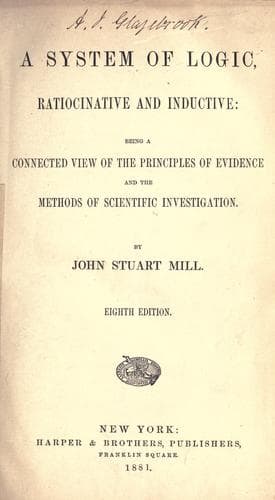
A System of Logic, Ratiocinative and InductiveMill, John Stuart
PhilosophyPhilosophy
A System of Logic, Ratiocinative and Inductive
Mill, John Stuart
Knowledge, Theory of; Logic; Science -- Methodology
An intermediate case is that of a name used _analogically_ or
metaphorically; that is, a name which is predicated of two things, not
univocally, or exactly in the same signification, but in significations
somewhat similar, and which being derived one from the other, one of them
may be considered the primary, and the other a secondary signification. As
when we speak of a brilliant light and a brilliant achievement. The word
is not applied in the same sense to the light and to the achievement; but
having been applied to the light in its original sense, that of brightness
to the eye, it is transferred to the achievement in a derivative
signification, supposed to be somewhat like the primitive one. The word,
however, is just as properly two names instead of one, in this case, as in
that of the most perfect ambiguity. And one of the commonest forms of
fallacious reasoning arising from ambiguity, is that of arguing from a
metaphorical expression as if it were literal; that is, as if a word, when
applied metaphorically, were the same name as when taken in its original
sense: which will be seen more particularly in its place.
Chapter III.
Of The Things Denoted By Names.
§ 1. Looking back now to the commencement of our inquiry, let us attempt
to measure how far it has advanced. Logic, we found, is the Theory of
Proof. But proof supposes something provable, which must be a Proposition
or Assertion; since nothing but a Proposition can be an object of belief,
or therefore of proof. A Proposition is, discourse which affirms or denies
something of some other thing. This is one step: there must, it seems, be
two things concerned in every act of belief. But what are these Things?
They can be no other than those signified by the two names, which being
joined together by a copula constitute the Proposition. If, therefore, we
knew what all names signify, we should know every thing which, in the
existing state of human knowledge, is capable either of being made a
subject of affirmation or denial, or of being itself affirmed or denied of
a subject. We have accordingly, in the preceding chapter, reviewed the
various kinds of Names, in order to ascertain what is signified by each of
them. And we have now carried this survey far enough to be able to take an
account of its results, and to exhibit an enumeration of all kinds of
Things which are capable of being made predicates, or of having any thing
predicated of them: after which to determine the import of Predication,
that is, of Propositions, can be no arduous task.
Public-domain text, read in full here on John Shaqi.
Reviews
Reviews
No reviews yet
Be the first to share your thoughts on this work.
Join the Discussion
Join the discussion
Sign in to leave a comment or review.
Sign InorCreate an account