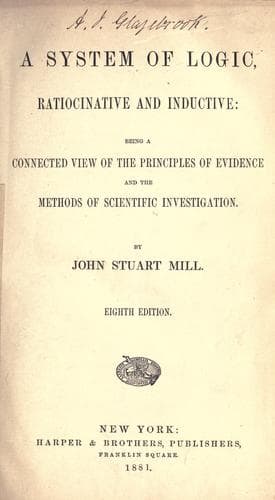
A System of Logic, Ratiocinative and InductiveMill, John Stuart
PhilosophyPhilosophy
A System of Logic, Ratiocinative and Inductive
Mill, John Stuart
Knowledge, Theory of; Logic; Science -- Methodology
§ 2. Before recommencing, under better auspices, the attempt made with
such imperfect success by the early logicians, we must take notice of an
unfortunate ambiguity in all the concrete names which correspond to the
most general of all abstract terms, the word Existence. When we have
occasion for a name which shall be capable of denoting whatever exists, as
contradistinguished from non-entity or Nothing, there is hardly a word
applicable to the purpose which is not also, and even more familiarly,
taken in a sense in which it denotes only substances. But substances are
not all that exists; attributes, if such things are to be spoken of, must
be said to exist; feelings certainly exist. Yet when we speak of an
_object_, or of a _thing_, we are almost always supposed to mean a
substance. There seems a kind of contradiction in using such an expression
as that one _thing_ is merely an attribute of another thing. And the
announcement of a Classification of Things would, I believe, prepare most
readers for an enumeration like those in natural history, beginning with
the great divisions of animal, vegetable, and mineral, and subdividing
them into classes and orders. If, rejecting the word Thing, we endeavor to
find another of a more general import, or at least more exclusively
confined to that general import, a word denoting all that exists, and
connoting only simple existence; no word might be presumed fitter for such
a purpose than _being_: originally the present participle of a verb which
in one of its meanings is exactly equivalent to the verb _exists_; and
therefore suitable, even by its grammatical formation, to be the concrete
of the abstract _existence_. But this word, strange as the fact may
appear, is still more completely spoiled for the purpose which it seemed
expressly made for, than the word Thing. _Being_ is, by custom, exactly
synonymous with substance; except that it is free from a slight taint of a
second ambiguity; being implied impartially to matter and to mind, while
substance, though originally and in strictness applicable to both, is apt
to suggest in preference the idea of matter. Attributes are never called
Beings; nor are feelings. A Being is that which excites feelings, and
which possesses attributes. The soul is called a Being; God and angels are
called Beings; but if we were to say, extension, color, wisdom, virtue,
are beings, we should perhaps be suspected of thinking with some of the
ancients, that the cardinal virtues are animals; or, at the least, of
holding with the Platonic school the doctrine of self-existent Ideas, or
with the followers of Epicurus that of Sensible Forms, which detach
themselves in every direction from bodies, and by coming in contact with
our organs, cause our perceptions. We should be supposed, in short, to
believe that Attributes are Substances.
Public-domain text, read in full here on John Shaqi.
Reviews
Reviews
No reviews yet
Be the first to share your thoughts on this work.
Join the Discussion
Join the discussion
Sign in to leave a comment or review.
Sign InorCreate an account