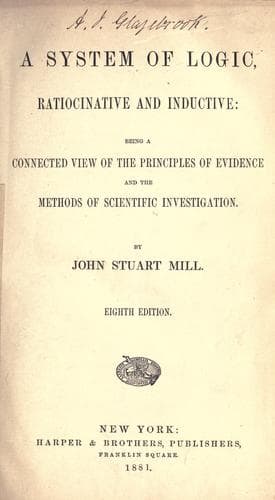
A System of Logic, Ratiocinative and InductiveMill, John Stuart
PhilosophyPhilosophy
A System of Logic, Ratiocinative and Inductive
Mill, John Stuart
Knowledge, Theory of; Logic; Science -- Methodology
The necessity of an enumeration of Existences, as the basis of Logic, did
not escape the attention of the schoolmen, and of their master Aristotle,
the most comprehensive, if not also the most sagacious, of the ancient
philosophers. The Categories, or Predicaments—the former a Greek word, the
latter its literal translation in the Latin language—were believed to be
an enumeration of all things capable of being named; an enumeration by the
_summa genera_, _i.e._, the most extensive classes into which things could
be distributed; which, therefore, were so many highest Predicates, one or
other of which was supposed capable of being affirmed with truth of every
namable thing whatsoever. The following are the classes into which,
according to this school of philosophy, Things in general might be
reduced:
Οὐσία, Substantia.
Ποσὸν, Quantitas.
Ποιόν, Qualitas.
Πρός τι, Relatio.
Ποιεῖν, Actio.
Πάσχειν, Passio.
Ποῦ, Ubi.
Πότε, Quando.
Κεῖσθακ, Situs.
Ἔχειν, Habitus.
The imperfections of this classification are too obvious to require, and
its merits are not sufficient to reward, a minute examination. It is a
mere catalogue of the distinctions rudely marked out by the language of
familiar life, with little or no attempt to penetrate, by philosophic
analysis, to the _rationale_ even of those common distinctions. Such an
analysis, however superficially conducted, would have shown the
enumeration to be both redundant and defective. Some objects are omitted,
and others repeated several times under different heads. It is like a
division of animals into men, quadrupeds, horses, asses, and ponies. That,
for instance, could not be a very comprehensive view of the nature of
Relation which could exclude action, passivity, and local situation from
that category. The same observation applies to the categories Quando (or
position in time), and Ubi (or position in space); while the distinction
between the latter and Situs is merely verbal. The incongruity of erecting
into a _summum genus_ the class which forms the tenth category is
manifest. On the other hand, the enumeration takes no notice of any thing
besides substances and attributes. In what category are we to place
sensations, or any other feelings and states of mind; as hope, joy, fear;
sound, smell, taste; pain, pleasure; thought, judgment, conception, and
the like? Probably all these would have been placed by the Aristotelian
school in the categories of _actio_ and _passio_; and the relation of such
of them as are active, to their objects, and of such of them as are
passive, to their causes, would rightly be so placed; but the things
themselves, the feelings or states of mind, wrongly. Feelings, or states
of consciousness, are assuredly to be accounted among realities, but they
can not be reckoned either among substances or attributes.(17)
Public-domain text, read in full here on John Shaqi.
Reviews
Reviews
No reviews yet
Be the first to share your thoughts on this work.
Join the Discussion
Join the discussion
Sign in to leave a comment or review.
Sign InorCreate an account