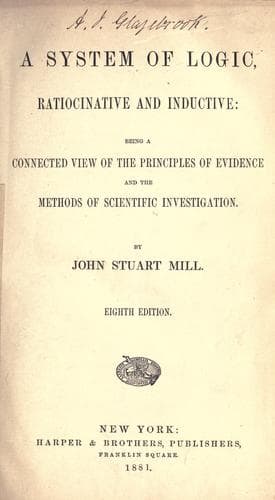
A System of Logic, Ratiocinative and InductiveMill, John Stuart
PhilosophyPhilosophy
A System of Logic, Ratiocinative and Inductive
Mill, John Stuart
Knowledge, Theory of; Logic; Science -- Methodology
When it is impossible to obtain good tools, the next best thing is to
understand thoroughly the defects of those we have. I have therefore
warned the reader of the ambiguity of the names which, for want of better,
I am necessitated to employ. It must now be the writer’s endeavor so to
employ them as in no case to leave the meaning doubtful or obscure. No one
of the above terms being altogether unambiguous, I shall not confine
myself to any one, but shall employ on each occasion the word which seems
least likely in the particular case to lead to misunderstanding; nor do I
pretend to use either these or any other words with a rigorous adherence
to one single sense. To do so would often leave us without a word to
express what is signified by a known word in some one or other of its
senses: unless authors had an unlimited license to coin new words,
together with (what it would be more difficult to assume) unlimited power
of making readers understand them. Nor would it be wise in a writer, on a
subject involving so much of abstraction, to deny himself the advantage
derived from even an improper use of a term, when, by means of it, some
familiar association is called up which brings the meaning home to the
mind, as it were by a flash.
The difficulty both to the writer and reader, of the attempt which must be
made to use vague words so as to convey a precise meaning, is not wholly a
matter of regret. It is not unfitting that logical treatises should afford
an example of that, to facilitate which is among the most important uses
of logic. Philosophical language will for a long time, and popular
language still longer, retain so much of vagueness and ambiguity, that
logic would be of little value if it did not, among its other advantages,
exercise the understanding in doing its work neatly and correctly with
these imperfect tools.
After this preamble it is time to proceed to our enumeration. We shall
commence with Feelings, the simplest class of namable things; the term
Feeling being of course understood in its most enlarged sense.
I. Feelings, Or States of Consciousness.
Public-domain text, read in full here on John Shaqi.
Reviews
Reviews
No reviews yet
Be the first to share your thoughts on this work.
Join the Discussion
Join the discussion
Sign in to leave a comment or review.
Sign InorCreate an account