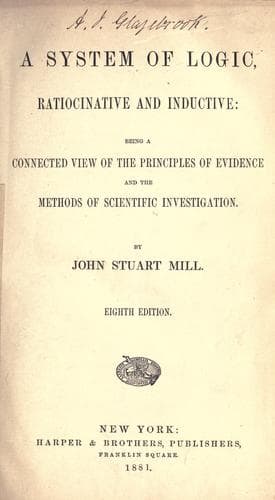
A System of Logic, Ratiocinative and InductiveMill, John Stuart
PhilosophyPhilosophy
A System of Logic, Ratiocinative and Inductive
Mill, John Stuart
Knowledge, Theory of; Logic; Science -- Methodology
§ 3. A Feeling and a State of consciousness are, in the language of
philosophy, equivalent expressions: every thing is a feeling of which the
mind is conscious; every thing which it _feels_, or, in other words, which
forms a part of its own sentient existence. In popular language Feeling is
not always synonymous with State of Consciousness; being often taken more
peculiarly for those states which are conceived as belonging to the
sensitive, or to the emotional, phasis of our nature, and sometimes, with
a still narrower restriction, to the emotional alone, as distinguished
from what are conceived as belonging to the percipient or to the
intellectual phasis. But this is an admitted departure from correctness of
language; just as, by a popular perversion the exact converse of this, the
word Mind is withdrawn from its rightful generality of signification, and
restricted to the intellect. The still greater perversion by which Feeling
is sometimes confined not only to bodily sensations, but to the sensations
of a single sense, that of touch, needs not be more particularly adverted
to.
Feeling, in the proper sense of the term, is a genus, of which Sensation,
Emotion, and Thought, are subordinate species. Under the word Thought is
here to be included whatever we are internally conscious of when we are
said to think; from the consciousness we have when we think of a red color
without having it before our eyes, to the most recondite thoughts of a
philosopher or poet. Be it remembered, however, that by a thought is to be
understood what passes in the mind itself, and not any object external to
the mind, which the person is commonly said to be thinking of. He may be
thinking of the sun, or of God, but the sun and God are not thoughts; his
mental image, however, of the sun, and his idea of God, are thoughts;
states of his mind, not of the objects themselves; and so also is his
belief of the existence of the sun, or of God; or his disbelief, if the
case be so. Even imaginary objects (which are said to exist only in our
ideas) are to be distinguished from our ideas of them. I may think of a
hobgoblin, as I may think of the loaf which was eaten yesterday, or of the
flower which will bloom to-morrow. But the hobgoblin which never existed
is not the same thing with my idea of a hobgoblin, any more than the loaf
which once existed is the same thing with my idea of a loaf, or the flower
which does not yet exist, but which will exist, is the same with my idea
of a flower. They are all, not thoughts, but objects of thought; though at
the present time all the objects are alike non-existent.
Public-domain text, read in full here on John Shaqi.
Reviews
Reviews
No reviews yet
Be the first to share your thoughts on this work.
Join the Discussion
Join the discussion
Sign in to leave a comment or review.
Sign InorCreate an account