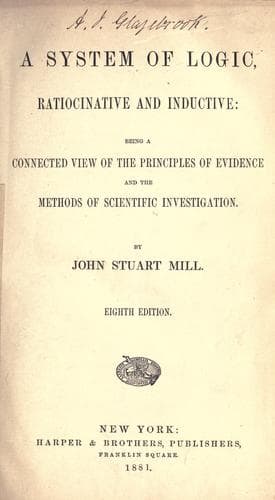
A System of Logic, Ratiocinative and InductiveMill, John Stuart
PhilosophyPhilosophy
A System of Logic, Ratiocinative and Inductive
Mill, John Stuart
Knowledge, Theory of; Logic; Science -- Methodology
These acts of what is termed perception, whatever be the conclusion
ultimately come to respecting their nature, must, I conceive, take their
place among the varieties of feelings or states of mind. In so classing
them, I have not the smallest intention of declaring or insinuating any
theory as to the law of mind in which these mental processes may be
supposed to originate, or the conditions under which they may be
legitimate or the reverse. Far less do I mean (as Dr. Whewell seems to
suppose must be meant in an analogous case(18)) to indicate that as they
are “_merely_ states of mind,” it is superfluous to inquire into their
distinguishing peculiarities. I abstain from the inquiry as irrelevant to
the science of logic. In these so-called perceptions, or direct
recognitions by the mind, of objects, whether physical or spiritual, which
are external to itself, I can see only cases of belief; but of belief
which claims to be intuitive, or independent of external evidence. When a
stone lies before me, I am conscious of certain sensations which I receive
from it; but if I say that these sensations come to me from an external
object which I _perceive_, the meaning of these words is, that receiving
the sensations, I intuitively _believe_ that an external cause of those
sensations exists. The laws of intuitive belief, and the conditions under
which it is legitimate, are a subject which, as we have already so often
remarked, belongs not to logic, but to the science of the ultimate laws of
the human mind.
To the same region of speculation belongs all that can be said respecting
the distinction which the German metaphysicians and their French and
English followers so elaborately draw between the _acts_ of the mind and
its merely passive _states_; between what it receives from, and what it
gives to, the crude materials of its experience. I am aware that with
reference to the view which those writers take of the primary elements of
thought and knowledge, this distinction is fundamental. But for the
present purpose, which is to examine, not the original groundwork of our
knowledge, but how we come by that portion of it which is not original;
the difference between active and passive states of mind is of secondary
importance. For us, they all are states of mind, they all are feelings; by
which, let it be said once more, I mean to imply nothing of passivity, but
simply that they are psychological facts, facts which take place in the
mind, and are to be carefully distinguished from the external or physical
facts with which they may be connected either as effects or as causes.
Public-domain text, read in full here on John Shaqi.
Reviews
Reviews
No reviews yet
Be the first to share your thoughts on this work.
Join the Discussion
Join the discussion
Sign in to leave a comment or review.
Sign InorCreate an account