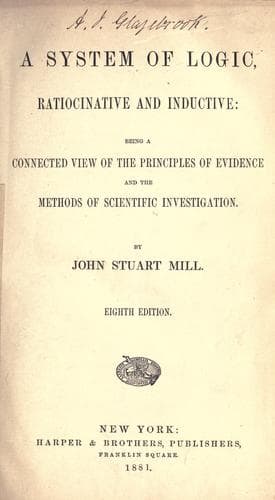
A System of Logic, Ratiocinative and InductiveMill, John Stuart
PhilosophyPhilosophy
A System of Logic, Ratiocinative and Inductive
Mill, John Stuart
Knowledge, Theory of; Logic; Science -- Methodology
§ 5. Among active states of mind, there is, however, one species which
merits particular attention, because it forms a principal part of the
connotation of some important classes of names. I mean _volitions_, or
acts of the will. When we speak of sentient beings by relative names, a
large portion of the connotation of the name usually consists of the
actions of those beings; actions past, present, and possible or probable
future. Take, for instance, the words Sovereign and Subject. What meaning
do these words convey, but that of innumerable actions, done or to be done
by the sovereign and the subjects, to or in regard to one another
reciprocally? So with the words physician and patient, leader and
follower, tutor and pupil. In many cases the words also connote actions
which would be done under certain contingencies by persons other than
those denoted: as the words mortgagor and mortgagee, obligor and obligee,
and many other words expressive of legal relation, which connote what a
court of justice would do to enforce the legal obligation if not
fulfilled. There are also words which connote actions previously done by
persons other than those denoted either by the name itself or by its
correlative; as the word brother. From these instances, it may be seen how
large a portion of the connotation of names consists of actions. Now what
is an action? Not one thing, but a series of two things: the state of mind
called a volition, followed by an effect. The volition or intention to
produce the effect, is one thing; the effect produced in consequence of
the intention, is another thing; the two together constitute the action. I
form the purpose of instantly moving my arm; that is a state of my mind:
my arm (not being tied or paralytic) moves in obedience to my purpose;
that is a physical fact, consequent on a state of mind. The intention,
followed by the fact, or (if we prefer the expression) the fact when
preceded and caused by the intention, is called the action of moving my
arm.
§ 6. Of the first leading division of namable things, viz., Feelings or
States of Consciousness, we began by recognizing three subdivisions;
Sensations, Thoughts, and Emotions. The first two of these we have
illustrated at considerable length; the third, Emotions, not being
perplexed by similar ambiguities, does not require similar
exemplification. And, finally, we have found it necessary to add to these
three a fourth species, commonly known by the name Volitions. We shall now
proceed to the two remaining classes of namable things; all things which
are regarded as external to the mind being considered as belonging either
to the class of Substances or to that of Attributes.
II. Substances.
Public-domain text, read in full here on John Shaqi.
Reviews
Reviews
No reviews yet
Be the first to share your thoughts on this work.
Join the Discussion
Join the discussion
Sign in to leave a comment or review.
Sign InorCreate an account