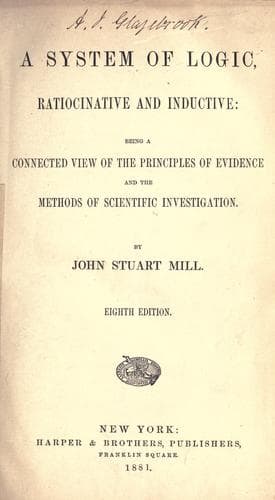
A System of Logic, Ratiocinative and InductiveMill, John Stuart
PhilosophyPhilosophy
A System of Logic, Ratiocinative and Inductive
Mill, John Stuart
Knowledge, Theory of; Logic; Science -- Methodology
Logicians have endeavored to define Substance and Attribute; but their
definitions are not so much attempts to draw a distinction between the
things themselves, as instructions what difference it is customary to make
in the grammatical structure of the sentence, according as we are speaking
of substances or of attributes. Such definitions are rather lessons of
English, or of Greek, Latin, or German, than of mental philosophy. An
attribute, say the school logicians, must be the attribute _of_ something;
color, for example, must be the color _of_ something; goodness must be the
goodness _of_ something; and if this something should cease to exist, or
should cease to be connected with the attribute, the existence of the
attribute would be at an end. A substance, on the contrary, is
self-existent; in speaking about it, we need not put _of_ after its name.
A stone is not the stone of any thing; the moon is not the moon _of_ any
thing, but simply the moon. Unless, indeed, the name which we choose to
give to the substance be a relative name; if so, it must be followed
either by _of_, or by some other particle, implying, as that preposition
does, a reference to something else: but then the other characteristic
peculiarity of an attribute would fail; the _something_ might be
destroyed, and the substance might still subsist. Thus, a father must be
the father _of_ something, and so far resembles an attribute, in being
referred to something besides himself: if there were no child, there would
be no father: but this, when we look into the matter, only means that we
should not call him father. The man called father might still exist though
there were no child, as he existed before there was a child; and there
would be no contradiction in supposing him to exist, though the whole
universe except himself were destroyed. But destroy all white substances,
and where would be the attribute whiteness? Whiteness, without any white
thing, is a contradiction in terms.
This is the nearest approach to a solution of the difficulty, that will be
found in the common treatises on logic. It will scarcely be thought to be
a satisfactory one. If an attribute is distinguished from a substance by
being the attribute _of_ something, it seems highly necessary to
understand what is meant by _of_; a particle which needs explanation too
much itself, to be placed in front of the explanation of any thing else.
And as for the self-existence of substance, it is very true that a
substance may be conceived to exist without any other substance, but so
also may an attribute without any other attribute: and we can no more
imagine a substance without attributes than we can imagine attributes
without a substance.
Public-domain text, read in full here on John Shaqi.
Reviews
Reviews
No reviews yet
Be the first to share your thoughts on this work.
Join the Discussion
Join the discussion
Sign in to leave a comment or review.
Sign InorCreate an account