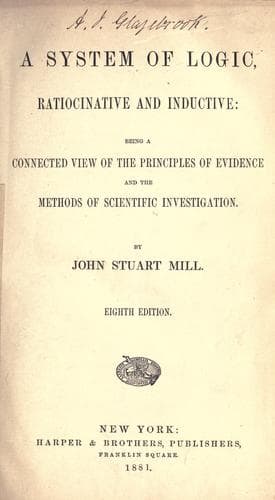
A System of Logic, Ratiocinative and InductiveMill, John Stuart
PhilosophyPhilosophy
A System of Logic, Ratiocinative and Inductive
Mill, John Stuart
Knowledge, Theory of; Logic; Science -- Methodology
But although the extreme doctrine of the Idealist metaphysicians, that
objects are nothing but our sensations and the laws which connect them,
has not been generally adopted by subsequent thinkers; the point of most
real importance is one on which those metaphysicians are now very
generally considered to have made out their case: viz., that _all we know_
of objects is the sensations which they give us, and the order of the
occurrence of those sensations. Kant himself, on this point, is as
explicit as Berkeley or Locke. However firmly convinced that there exists
a universe of “Things in themselves,” totally distinct from the universe
of phenomena, or of things as they appear to our senses; and even when
bringing into use a technical expression (_Noumenon_) to denote what the
thing is in itself, as contrasted with the _representation_ of it in our
minds; he allows that this representation (the matter of which, he says,
consists of our sensations, though the form is given by the laws of the
mind itself) is all we know of the object: and that the real nature of the
Thing is, and by the constitution of our faculties ever must remain, at
least in the present state of existence, an impenetrable mystery to us.
“Of things absolutely or in themselves,” says Sir William Hamilton,(19)
“be they external, be they internal, we know nothing, or know them only as
incognizable; and become aware of their incomprehensible existence, only
as this is indirectly and accidentally revealed to us, through certain
qualities related to our faculties of knowledge, and which qualities,
again, we can not think as unconditional, irrelative, existent in and of
ourselves. All that we know is therefore phenomenal—phenomenal of the
unknown.”(20) The same doctrine is laid down in the clearest and strongest
terms by M. Cousin, whose observations on the subject are the more worthy
of attention, as, in consequence of the ultra-German and ontological
character of his philosophy in other respects, they may be regarded as the
admissions of an opponent.(21)
There is not the slightest reason for believing that what we call the
sensible qualities of the object are a type of any thing inherent in
itself, or bear any affinity to its own nature. A cause does not, as such,
resemble its effects; an east wind is not like the feeling of cold, nor
heat like the steam of boiling water. Why then should matter resemble our
sensations? Why should the inmost nature of fire or water resemble the
impressions made by those objects upon our senses?(22) Or on what
principle are we authorized to deduce from the effects, any thing
concerning the cause, except that it is a cause adequate to produce those
effects? It may, therefore, safely be laid down as a truth both obvious in
itself, and admitted by all whom it is at present necessary to take into
consideration, that, of the outward world, we know and can know absolutely
nothing, except the sensations which we experience from it.(23)
Public-domain text, read in full here on John Shaqi.
A System of Logic, Ratiocinative and Inductive — John Shaqi
Reviews
Reviews
No reviews yet
Be the first to share your thoughts on this work.
Join the Discussion
Join the discussion
Sign in to leave a comment or review.
Sign InorCreate an account