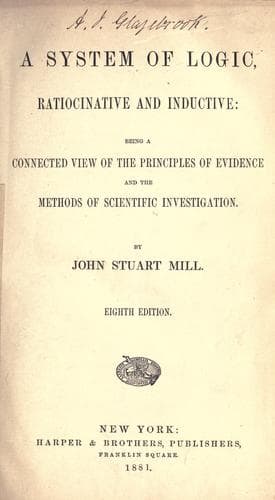
A System of Logic, Ratiocinative and InductiveMill, John Stuart
PhilosophyPhilosophy
A System of Logic, Ratiocinative and Inductive
Mill, John Stuart
Knowledge, Theory of; Logic; Science -- Methodology
§ 8. Body having now been defined the external cause, and (according to
the more reasonable opinion) the unknown external cause, to which we refer
our sensations; it remains to frame a definition of Mind. Nor, after the
preceding observations, will this be difficult. For, as our conception of
a body is that of an unknown exciting cause of sensations, so our
conception of a mind is that of an unknown recipient or percipient, of
them; and not of them alone, but of all our other feelings. As body is
understood to be the mysterious something which excites the mind to feel,
so mind is the mysterious something which feels and thinks. It is
unnecessary to give in the case of mind, as we gave in the case of matter,
a particular statement of the skeptical system by which its existence as a
Thing in itself, distinct from the series of what are denominated its
states, is called in question. But it is necessary to remark, that on the
inmost nature (whatever be meant by inmost nature) of the thinking
principle, as well as on the inmost nature of matter, we are, and with our
faculties must always remain, entirely in the dark. All which we are aware
of, even in our own minds, is (in the words of James Mill) a certain
“thread of consciousness;” a series of feelings, that is, of sensations,
thoughts, emotions, and volitions, more or less numerous and complicated.
There is a something I call Myself, or, by another form of expression, my
mind, which I consider as distinct from these sensations, thoughts, etc.;
a something which I conceive to be not the thoughts, but the being that
has the thoughts, and which I can conceive as existing forever in a state
of quiescence, without any thoughts at all. But what this being is, though
it is myself, I have no knowledge, other than the series of its states of
consciousness. As bodies manifest themselves to me only through the
sensations of which I regard them as the causes, so the thinking
principle, or mind, in my own nature, makes itself known to me only by the
feelings of which it is conscious. I know nothing about myself, save my
capacities of feeling or being conscious (including, of course, thinking
and willing): and were I to learn any thing new concerning my own nature,
I can not with my present faculties conceive this new information to be
any thing else, than that I have some additional capacities, as yet
unknown to me, of feeling, thinking, or willing.
Public-domain text, read in full here on John Shaqi.
Reviews
Reviews
No reviews yet
Be the first to share your thoughts on this work.
Join the Discussion
Join the discussion
Sign in to leave a comment or review.
Sign InorCreate an account