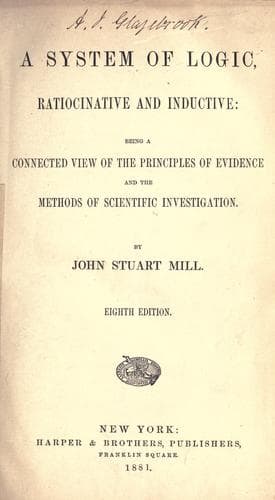
A System of Logic, Ratiocinative and InductiveMill, John Stuart
PhilosophyPhilosophy
A System of Logic, Ratiocinative and Inductive
Mill, John Stuart
Knowledge, Theory of; Logic; Science -- Methodology
This is one view which may be taken of the subject. But there is also
another and a different view. It may be said, that it is true we _know_
nothing of sensible objects, except the sensations they excite in us; that
the fact of our receiving from snow the particular sensation which is
called a sensation of white, is the _ground_ on which we ascribe to that
substance the quality whiteness; the sole proof of its possessing that
quality. But because one thing may be the sole evidence of the existence
of another thing, it does not follow that the two are one and the same.
The attribute whiteness (it may be said) is not the fact of receiving the
sensation, but something in the object itself; a _power_ inherent in it;
something _in virtue_ of which the object produces the sensation. And when
we affirm that snow possesses the attribute whiteness, we do not merely
assert that the presence of snow produces in us that sensation, but that
it does so through, and by reason of, that power or quality.
For the purposes of logic it is not of material importance which of these
opinions we adopt. The full discussion of the subject belongs to the other
department of scientific inquiry, so often alluded to under the name of
metaphysics; but it may be said here, that for the doctrine of the
existence of a peculiar species of entities called qualities, I can see no
foundation except in a tendency of the human mind which is the cause of
many delusions. I mean, the disposition, wherever we meet with two names
which are not precisely synonymous, to suppose that they must be the names
of two different things; whereas in reality they may be names of the same
thing viewed in two different lights, or under different suppositions as
to surrounding circumstances. Because _quality_ and _sensation_ can not be
put indiscriminately one for the other, it is supposed that they can not
both signify the same thing, namely, the impression or feeling with which
we are affected through our senses by the presence of an object; though
there is at least no absurdity in supposing that this identical impression
or feeling may be called a sensation when considered merely in itself, and
a quality when looked at in relation to any one of the numerous objects,
the presence of which to our organs excites in our minds that among
various other sensations or feelings. And if this be admissible as a
supposition, it rests with those who contend for an entity _per se_ called
a quality, to show that their opinion is preferable, or is any thing in
fact but a lingering remnant of the old doctrine of occult causes; the
very absurdity which Molière so happily ridiculed when he made one of his
pedantic physicians account for the fact that opium produces sleep by the
maxim, Because it has a soporific virtue.
Public-domain text, read in full here on John Shaqi.
Reviews
Reviews
No reviews yet
Be the first to share your thoughts on this work.
Join the Discussion
Join the discussion
Sign in to leave a comment or review.
Sign InorCreate an account