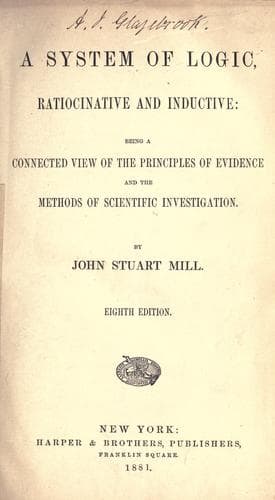
A System of Logic, Ratiocinative and InductiveMill, John Stuart
PhilosophyPhilosophy
A System of Logic, Ratiocinative and Inductive
Mill, John Stuart
Knowledge, Theory of; Logic; Science -- Methodology
Thus, then, as body is the unsentient cause to which we are naturally
prompted to refer a certain portion of our feelings, so mind may be
described as the sentient _subject_ (in the scholastic sense of the term)
of all feelings; that which has or feels them. But of the nature of either
body or mind, further than the feelings which the former excites, and
which the latter experiences, we do not, according to the best existing
doctrine, know any thing; and if any thing, logic has nothing to do with
it, or with the manner in which the knowledge is acquired. With this
result we may conclude this portion of our subject, and pass to the third
and only remaining class or division of Namable Things.
III. Attributes: and, first, Qualities.
§ 9. From what has already been said of Substance, what is to be said of
Attribute is easily deducible. For if we know not, and can not know, any
thing of bodies but the sensations which they excite in us or in others,
those sensations must be all that we can, at bottom, mean by their
attributes; and the distinction which we verbally make between the
properties of things and the sensations we receive from them, must
originate in the convenience of discourse rather than in the nature of
what is signified by the terms.
Attributes are usually distributed under the three heads of Quality,
Quantity, and Relation. We shall come to the two latter presently: in the
first place we shall confine ourselves to the former.
Let us take, then, as our example, one of what are termed the sensible
qualities of objects, and let that example be whiteness. When we ascribe
whiteness to any substance, as, for instance, snow; when we say that snow
has the quality whiteness, what do we really assert? Simply, that when
snow is present to our organs, we have a particular sensation, which we
are accustomed to call the sensation of white. But how do I know that snow
is present? Obviously by the sensations which I derive from it, and not
otherwise. I infer that the object is present, because it gives me a
certain assemblage or series of sensations. And when I ascribe to it the
attribute whiteness, my meaning is only, that, of the sensations composing
this group or series, that which I call the sensation of white color is
one.
Public-domain text, read in full here on John Shaqi.
Reviews
Reviews
No reviews yet
Be the first to share your thoughts on this work.
Join the Discussion
Join the discussion
Sign in to leave a comment or review.
Sign InorCreate an account