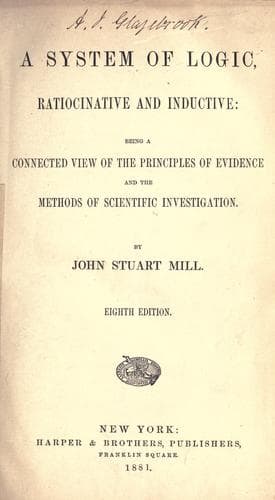
A System of Logic, Ratiocinative and InductiveMill, John Stuart
PhilosophyPhilosophy
A System of Logic, Ratiocinative and Inductive
Mill, John Stuart
Knowledge, Theory of; Logic; Science -- Methodology
The distinction is real and important. But, as has been seen, an
Attribute, when it is any thing but a simple unanalyzable Resemblance
between the subject and some other things, consists in causing impressions
of some sort on consciousness. Consequently, the co-inherence of two
attributes is but the co-existence of the two states of consciousness
implied in their meaning: with the difference, however, that this
co-existence is sometimes potential only, the attribute being considered
as in existence, though the fact on which it is grounded may not be
actually, but only potentially present. Snow, for instance, is, with great
convenience, said to be white even in a state of total darkness, because,
though we are not now conscious of the color, we shall be conscious of it
as soon as morning breaks. Co-inherence of attributes is therefore still a
case, though a complex one, of co-existence of states of consciousness; a
totally different thing, however, from Order in Place. Being a part of
simultaneity, it belongs not to Place but to Time.
We may therefore (and we shall sometimes find it a convenience) instead of
Co-existence and Sequence, say, for greater particularity, Order in Place
and Order in Time: Order in Place being a specific mode of co-existence,
not necessary to be more particularly analyzed here; while the mere fact
of co-existence, whether between actual sensations, or between the
potentialities of causing them, known by the name of attributes, may be
classed, together with Sequence, under the head of Order in Time.
§ 7. In the foregoing inquiry into the import of propositions, we have
thought it necessary to analyze directly those alone, in which the terms
of the proposition (or the predicate at least) are concrete terms. But, in
doing so, we have indirectly analyzed those in which the terms are
abstract. The distinction between an abstract term and its corresponding
concrete, does not turn upon any difference in what they are appointed to
signify; for the real signification of a concrete general name is, as we
have so often said, its connotation; and what the concrete term connotes,
forms the entire meaning of the abstract name. Since there is nothing in
the import of an abstract name which is not in the import of the
corresponding concrete, it is natural to suppose that neither can there be
any thing in the import of a proposition of which the terms are abstract,
but what there is in some proposition which can be framed of concrete
terms.
Public-domain text, read in full here on John Shaqi.
Reviews
Reviews
No reviews yet
Be the first to share your thoughts on this work.
Elsewhere in the archive
Join the Discussion
Join the discussion
Sign in to leave a comment or review.
Sign InorCreate an account