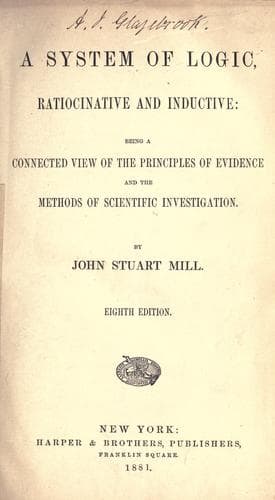
A System of Logic, Ratiocinative and InductiveMill, John Stuart
PhilosophyPhilosophy
A System of Logic, Ratiocinative and Inductive
Mill, John Stuart
Knowledge, Theory of; Logic; Science -- Methodology
And this presumption a closer examination will confirm. An abstract name
is the name of an attribute, or combination of attributes. The
corresponding concrete is a name given to things, because of, and in order
to express, their possessing that attribute, or that combination of
attributes. When, therefore, we predicate of any thing a concrete name,
the attribute is what we in reality predicate of it. But it has now been
shown that in all propositions of which the predicate is a concrete name,
what is really predicated is one of five things: Existence, Co-existence,
Causation, Sequence, or Resemblance. An attribute, therefore, is
necessarily either an existence, a co-existence, a causation, a sequence,
or a resemblance. When a proposition consists of a subject and predicate
which are abstract terms, it consists of terms which must necessarily
signify one or other of these things. When we predicate of any thing an
abstract name, we affirm of the thing that it is one or other of these
five things; that it is a case of Existence, or of Co-existence, or of
Causation, or of Sequence, or of Resemblance.
It is impossible to imagine any proposition expressed in abstract terms,
which can not be transformed into a precisely equivalent proposition in
which the terms are concrete; namely, either the concrete names which
connote the attributes themselves, or the names of the _fundamenta_ of
those attributes; the facts or phenomena on which they are grounded. To
illustrate the latter case, let us take this proposition, of which the
subject only is an abstract name, “Thoughtlessness is dangerous.”
Thoughtlessness is an attribute, grounded on the facts which we call
thoughtless actions; and the proposition is equivalent to this,
Thoughtless actions are dangerous. In the next example the predicate as
well as the subject are abstract names: “Whiteness is a color;” or “The
color of snow is a whiteness.” These attributes being grounded on
sensations, the equivalent propositions in the concrete would be, The
sensation of white is one of the sensations called those of color—The
sensation of sight, caused by looking at snow, is one of the sensations
called sensations of white. In these propositions, as we have before seen,
the matter-of-fact asserted is a Resemblance. In the following examples,
the concrete terms are those which directly correspond to the abstract
names; connoting the attribute which these denote. “Prudence is a virtue:”
this may be rendered, “All prudent persons, _in so far as_ prudent, are
virtuous:” “Courage is deserving of honor;” thus, “All courageous persons
are deserving of honor _in so far_ as they are courageous:” which is
equivalent to this—“All courageous persons deserve an addition to the
honor, or a diminution of the disgrace, which would attach to them on
other grounds.”
Public-domain text, read in full here on John Shaqi.
Reviews
Reviews
No reviews yet
Be the first to share your thoughts on this work.
Elsewhere in the archive
Join the Discussion
Join the discussion
Sign in to leave a comment or review.
Sign InorCreate an account