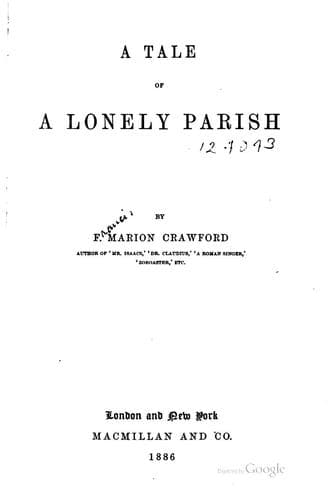
A Tale of a Lonely ParishCrawford, F. Marion (Francis Marion)
General
A Tale of a Lonely Parish
Crawford, F. Marion (Francis Marion)
Country life -- England -- Fiction; England -- Social life and customs -- Fiction
There had indeed been festivities at the vicarage to which as many as
three clergymen's wives had been invited, but these were rare indeed. For
months at a time Mrs. Ambrose reigned in undisputed possession of the
woman's social rights in Billingsfield. She was an excellent person in
every way. She had once been handsome and even now she was fine-looking,
of goodly stature, if also of goodly weight; rosy, even rubicund, in
complexion, and rotund of feature; looking at you rather severely out of
her large grey eyes, but able to smile very cheerfully and to show an
uncommonly good set of teeth; twisting her thick grey hair into a small
knot at the back of her head and then covering it with a neatly made cap
which she considered becoming to her time of life; dressed always with
extreme simplicity and neatness, glorying in her good sense and in her
stout shoes; speaking of things which she called "neat" with a devotional
admiration and expressing the extremest height of her disapprobation when
she said anything was "very untidy." A motherly woman, a practical woman,
a good housekeeper and a good wife, careful of small things because
generally only small things came in her way, devotedly attached to her
husband, whom she regarded with perfect justice as the best man of her
acquaintance, adding, however, with somewhat precipitous rashness that he
was the best man in the world. She took also a great interest in his
pupils and busied herself mightily with their welfare. Since the arrival
of the new doctor who was suspected of free-thinking, she had shown a
strong leaning towards homoeopathy, and prescribed small pellets of
belladonna for the Honourable Cornelius's cold and infinitesimal drops of
aconite for John Short's headaches, until she observed that John never
had a headache unless he had worked too much, and Angleside always had a
cold when he did not want to work at all. Especially in the department of
the commissariat she showed great activity, and the reputation the vicar
had acquired for feeding his pupils well had perhaps more to do with his
success than he imagined. She was never tired of repeating that
Englishmen needed plenty of good food, and she had no principles which
she did not practise. She even thought it right to lecture young
Angleside upon his idleness at stated intervals. He always replied with
great gentleness that he was awfully stupid, you know, and Mr. Ambrose
was awfully good about it and he hoped he should not be pulled when he
went up. And strange to relate he actually passed his examination and
matriculated, to his own immense astonishment and to the no small honour
and glory of the Reverend Augustin Ambrose, vicar of Billingsfield,
Essex. But when that great day arrived certain events occurred which are
worthy to be chronicled and remembered.
CHAPTER II.
Public-domain text, read in full here on John Shaqi.
Reviews
Reviews
No reviews yet
Be the first to share your thoughts on this work.
Join the Discussion
Join the discussion
Sign in to leave a comment or review.
Sign InorCreate an account