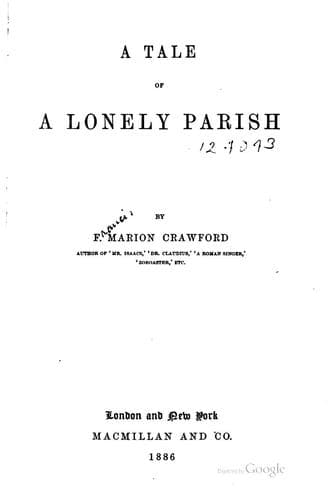
A Tale of a Lonely ParishCrawford, F. Marion (Francis Marion)
General
A Tale of a Lonely Parish
Crawford, F. Marion (Francis Marion)
Country life -- England -- Fiction; England -- Social life and customs -- Fiction
In the warm June weather young Angleside went up to pass his examination
for entrance at Trinity. There is nothing particularly interesting or
worthy of note in that simple process, though at that time the custom of
imposing an examination had only been recently imported from Oxford. For
one whole day forty or fifty young fellows from all parts of the country
sat at the long dining-tables in the beautiful old hall and wrote as
busily as they could, answering the printed questions before them, and
eyeing each other curiously from time to time. The weather was warm and
sultry, the trees were all in full leaf and Cambridge was deserted. Only
a few hard-reading men, who stayed up during the Long, wandered out with
books at the backs of the colleges or strayed slowly through the empty
courts, objects of considerable interest to the youths who had come up
for the entrance examination--chiefly pale men in rather shabby clothes
with old gowns and battered caps, and a general appearance of being the
worse for wear.
Angleside had been in Cambridge before and consequently lost no time in
returning to Billingsfield when the examination was over. Short was to
spend the summer at the vicarage, reading hard until the term began, when
he was to go up and compete for a minor scholarship; Angleside was to
wait until he heard whether he had passed, and was then going abroad to
meet his father and to rest from the extreme exertion of mastering the
"Apology" and the first books of the "Memorabilia." John drove over to
meet the Honourable Cornelius, who was in a terrible state of anxiety and
left him no peace on the way asking him again and again to repeat the
answers to the questions which had been proposed, reckoning up the ones
he had answered wrong and the ones he thought he might have answered
right, and coming each time to a different conclusion, finally lighting a
huge brierwood pipe and swearing "that it was a beastly shame to subject
human beings to such awful torture." John calmed him by saying he fancied
Cornelius had "got through"; for John's words were a species of gospel to
Cornelius. By the time they reached the vicarage Angleside felt sanguine
of his success.
The vicar was not visible. It was a strange and unheard of thing--there
were visitors in the drawing-room. This doubtless accounted for the fact
that the fly from the Duke's Head was standing on the opposite side of
the road. The two young men went into their study, which was on the
ground floor and opened upon the passage which led to the drawing-room
from the little hall. Angleside remarked that by leaving the door open
they would catch a glimpse of the visitor when he went out. But the
visitor stayed long. The curiosity of the two was wrought up to a high
pitch; it was many months since there had been a real visitor at the
vicarage. Angleside suggested going out and finding old Reynolds--he
always knew everything that was going on.
Public-domain text, read in full here on John Shaqi.
Reviews
Reviews
No reviews yet
Be the first to share your thoughts on this work.
Join the Discussion
Join the discussion
Sign in to leave a comment or review.
Sign InorCreate an account