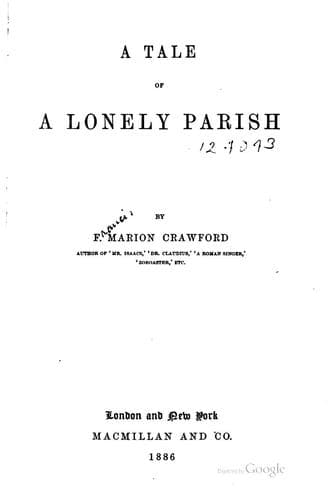
A Tale of a Lonely ParishCrawford, F. Marion (Francis Marion)
General
A Tale of a Lonely Parish
Crawford, F. Marion (Francis Marion)
Country life -- England -- Fiction; England -- Social life and customs -- Fiction
But Mrs. Goddard. did not sleep that night. She felt as though she could
never sleep again, and for many hours she lay thinking of the new element
of fear which had so suddenly come into her life at the very time when
she believed herself to be safe for many years to come. She longed to
know where her wretched husband was; whether he had found shelter for the
night, whether he was still free or whether he had even then fallen into
the hands of his pursuers. She knew that she could not have concealed him
in the house and that she had done all that lay in her power for him. But
she started at every sound, as the rain rattled against the shutters and
the wind howled down the chimney.
Walter Goddard, however, was safe for the present and was even
luxuriously lodged, considering his circumstances, for he was comfortably
installed amongst the hay in the barn of the "Feathers" inn. He had been
in Billingsfield since early in the afternoon and had considered
carefully the question of his quarters for the night. He had observed
from a distance the landlord of the said inn, and had boldly offered to
do a "day's work for a night's lodging." He said he was "tramping" his
way back from London to his home in Yorkshire; he knew enough of the
sound of the rough Yorkshire dialect to pass for a native of that county
amongst ignorant labourers who had never heard the real tongue. The
landlord of the Feathers consented to the bargain and Goddard was told
that he might sleep in the barn if he liked, and should take a turn at
cutting chaff the next day to pay for the convenience. The convict slept
soundly; he was past lying awake in useless fits of remorse, and he was
exhausted with his day's journey. Moreover he had now the immediate
prospect of obtaining sufficient money to carry him safely out of the
country, and once abroad he felt sure of baffling pursuit. He was an
accomplished man and spoke French with a fluency unusual in Englishmen;
he determined to get across the channel in some fishing craft; he would
then make his way to Paris and enlist in the Foreign Legion. It would be
safer than trying to go to America, where people were invariably caught
as they landed. It was a race for life and death, and he knew it. Had he
been able to obtain clothes, money and a disguise in London he would have
travelled by rail. But that had been impossible and it now seemed a wiser
plan to "tramp" it. His beard was growing rapidly and would soon make a
complete disguise. Village constables are generally simple people, easily
imposed upon, very different from London detectives; and hitherto he felt
sure that he had baffled pursuit by the mere simplicity of his
proceedings. The intelligent officials of Scotland Yard were used to
forgers and swindlers who travelled by express trains and crossed to
America by fashionable steamers. It did not strike them as very likely
that a man of Walter Goddard's previous tastes and habits could get
through the country in the guise of a tramp.
Public-domain text, read in full here on John Shaqi.
Reviews
Reviews
No reviews yet
Be the first to share your thoughts on this work.
Elsewhere in the archive
Join the Discussion
Join the discussion
Sign in to leave a comment or review.
Sign InorCreate an account