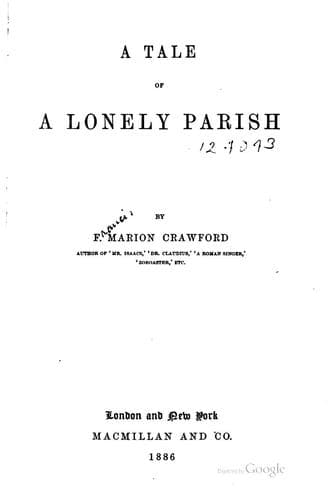
A Tale of a Lonely ParishCrawford, F. Marion (Francis Marion)
General
A Tale of a Lonely Parish
Crawford, F. Marion (Francis Marion)
Country life -- England -- Fiction; England -- Social life and customs -- Fiction
If he had been possessed at
the time of his escape of the money he so much desired he would probably
have been caught; as it was, he got away without difficulty, and at the
very time when every railway station and every port in the kingdom were
being watched for him, he was lurking in the purlieus of Whitechapel, and
then tramping his way east in comparative safety, half starved, it is
true, but unmolested.
That he was disappointed at the reception his wife had given him did not
prevent him from sleeping peacefully that night. One thing alone
disturbed him, and that was her mention of Mr. Juxon, in whose house, as
she had told him, she lived. It seems incredible that a man in Walter
Goddard's position, lost to every sense of honour, a criminal of the
worst type, who had deceived his wife before he was indicted for forgery,
who had certainly cared very little for her at any time, should now, in a
moment of supreme danger, feel a pang of jealousy on hearing that his
wife lived in the vicinity of the squire and occupied a house belonging
to him. But he was too bad himself not to suspect others, especially
those whom he had wronged, and the feeling was mingled with a strong
curiosity to know whether this woman, who now treated him so haughtily
and drew back from him as from some monstrous horror, was as good as she
pretended to be. He said to himself that on the next day at dawn he would
slip out of the barn and try whether he could not find some hiding-place
within easy reach of the cottage, so as to be able to watch her dwelling
at his ease throughout the day. The plan seemed a good one. Since he was
obliged to wait twenty-four hours in order to get the money he wanted, he
might as well employ the time profitably in observing his wife's habits.
It would be long, he said to himself with a bitter sneer, before he
troubled her again--he would just like to see.
Having come to this decision he drew some of the hay over his body and in
spite of cold and wet was soon peacefully asleep. But at early dawn he
awoke with the alacrity of a man who constantly expects pursuit, and
slipped down from the hayloft into the barn. There was no one stirring
and he got over the fence at the back of the yard and skirted the fields
in the direction of the church, finally climbing another stile and
entering what he supposed to be the park. On this side the back of the
church ran out into a broad meadow, where the larger portion of the
ancient abbey had once stood. Goddard walked along close by the church
walls. He knew from his observation on the previous afternoon that he
could thus come out into the road in the vicinity of the cottage, unless
his way through the park were interrupted by impassable wire fences. The
ground was very heavy and he was sure not to meet anybody in the meadows
in such weather.
Public-domain text, read in full here on John Shaqi.
Reviews
Reviews
No reviews yet
Be the first to share your thoughts on this work.
Elsewhere in the archive
Join the Discussion
Join the discussion
Sign in to leave a comment or review.
Sign InorCreate an account