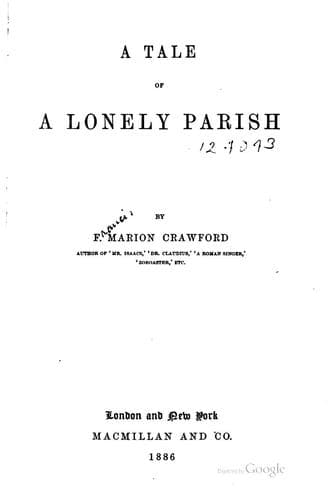
A Tale of a Lonely ParishCrawford, F. Marion (Francis Marion)
General
A Tale of a Lonely Parish
Crawford, F. Marion (Francis Marion)
Country life -- England -- Fiction; England -- Social life and customs -- Fiction
Suddenly he stopped and looked at a buttress that jutted out from the
church and for the existence of which there seemed to be no ostensible
reason. He examined it and found that it was not a buttress but
apparently a half ruined chamber, which at some former period had been
built upon the side of the abbey. Low down by the ground there was a
hole, where a few stones seemed to have been removed and not replaced.
Goddard knelt down in the long wet grass and put in his head; then he
crept in on his hands and knees and presently disappeared.
He found himself in a room about ten feet square, dimly lighted by a
small window at the top, and surrounded by long horizontal niches. The
floor, which was badly broken in some places, was of stone. Goddard
examined the place carefully. It was evidently an old vault of the kind
formerly built above ground for the lords of the manor; but the coffins,
if there had ever been any, had been removed elsewhere. Goddard laughed
to himself.
"I might stay here for a year, if I could get anything to eat," he said
to himself.
CHAPTER XIV.
The squire had grown used to the position in which he found himself after
Mary Goddard had told him her story. He continued his visits as formerly,
and it could hardly be said that there was any change in his manner
towards her; there was no need of any change, for even at the time when
he contemplated making her his wife there had been nothing lover-like
in his behaviour. He had been a friend and had treated her with all the
respect due to a lonely lady who was his tenant, and even with a certain
formality which had sometimes seemed unnecessary. But though there was no
apparent alteration in his mode of talking, in his habit of bringing her
flowers and books and of looking after the condition of the cottage, both
she and he were perfectly conscious of the fact that they understood each
other much better than before. They were united by the common bond of a
common secret which very closely concerned one of them. Things were not
as they had formerly been. Mrs. Goddard no longer felt that she had
anything to hide; the squire knew that he no longer had anything to hope.
If he had been a selfish man, if she had been a less sensible woman,
their friendship might have ended then and there. But Mr. Juxon was not
selfish, and Mary Goddard did not lack good sense. Having ascertained
that in the ordinary course of events there was no possibility of ever
marrying her, the squire did not at once give her over and go elsewhere;
on the contrary he showed himself more desirous than ever of assisting
her and amusing her. He was a patient man; his day might come yet, if
Goddard died. It did not follow that if he could not marry Mrs. Goddard
he must needs marry some one else; for it was not a wife that he sought,
but the companionship of this particular woman as his wife. If he could
not marry he could still enjoy at least a portion of that companionship,
Public-domain text, read in full here on John Shaqi.
Reviews
Reviews
No reviews yet
Be the first to share your thoughts on this work.
Elsewhere in the archive
Join the Discussion
Join the discussion
Sign in to leave a comment or review.
Sign InorCreate an account