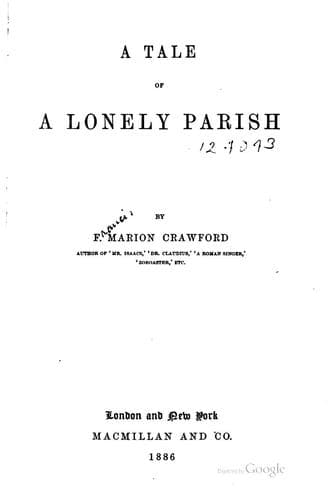
A Tale of a Lonely ParishCrawford, F. Marion (Francis Marion)
General
A Tale of a Lonely Parish
Crawford, F. Marion (Francis Marion)
Country life -- England -- Fiction; England -- Social life and customs -- Fiction
by visiting her daily and talking with her, and making himself a part of
her life. He judged things very coldly and lost himself in no lofty
flights of imagination. It was better that he should enjoy what fell in
his way in at least seeing Mrs. Goddard and possessing her friendship,
than that he should go out of his course in order to marry merely for the
sake of marrying. He had seen so much of the active side of life that he
was well prepared to revel in the peace which had fallen to his lot. He
cared little whether he left an heir to the park; there were others of
the name, and since the park had furnished matter for litigation during
forty years before he came into possession of it, it might supply the
lawyers with fees for forty years more after his death, for all he cared.
It would have been very desirable to marry Mrs. Goddard if it had been
possible, but since the thing could not be done at present it was best to
submit with a good grace. Since the day when his suit had suddenly come
to grief in the discovery of her real position, Mr. Juxon had
philosophically said to himself that he had perhaps been premature in
making his proposal, and that it was as well that it could not have been
accepted; perhaps she would not have made him a good wife; perhaps he had
deceived himself in thinking that because he liked her and desired her
friendship he really wished to marry her; perhaps all was for the best in
the best of all possible worlds, after all and in spite of all.
But these reflections, which tended to soothe the squire's annoyance at
the failure of a scheme which he had contemplated with so much delight,
did not prevent him from feeling the most sincere sympathy for Mrs.
Goddard, nor from constantly wishing that he could devise some plan for
helping her. She seemed never to have thought of divorcing herself from
her husband. The squire was not sure whether such a thing were possible;
he doubted it, and promised himself that he would get a lawyer's opinion
upon the matter. He believed that English law did not grant divorces on
account of the husband's being sentenced to any limited period of penal
servitude. But in any case it would be a very delicate subject to
approach, and Mr. Juxon amused himself by constructing conversations in
his mind which should lead up to this point without wounding poor Mrs.
Goddard's sensibilities. He was the kindest of men; he would not for
worlds have said a word which should recall to her that memorable day
when she had told him her story. And yet it would be quite impossible to
broach such a scheme without going at once into all the details of the
chief cause of her sorrows. The consequence was that in the windings of
his imagination the squire found himself perpetually turning in a vicious
circle; but since the exercise concerned Mrs. Goddard and her welfare it
was not uncongenial. He founded all his vague hopes upon one expression
she had used. When in making his proposal he had spoken of her as being a
Public-domain text, read in full here on John Shaqi.
Reviews
Reviews
No reviews yet
Be the first to share your thoughts on this work.
Elsewhere in the archive