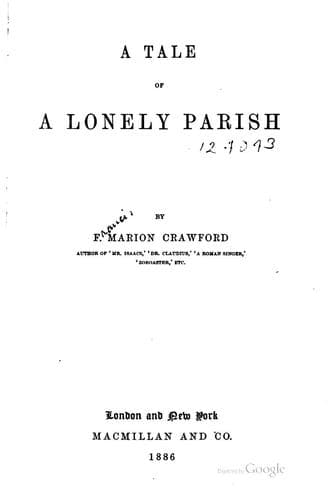
A Tale of a Lonely ParishCrawford, F. Marion (Francis Marion)
General
A Tale of a Lonely Parish
Crawford, F. Marion (Francis Marion)
Country life -- England -- Fiction; England -- Social life and customs -- Fiction
In due time the joyful news arrived from Cambridge that the Honourable
Cornelius had passed his examination and was at liberty to matriculate at
the beginning of the term. The intelligence was duly telegraphed to his
father, and in a few hours came a despatch in answer, full of
affectionate congratulation and requesting that Cornelius should proceed
at once to Paris, where his father was waiting for him. The young man
took an affectionate leave of the vicar, of Mrs. Ambrose and especially
of John Short, for whom he had conceived an almost superstitious
admiration; old Reynolds was not forgotten in the farewell, and for
several days after Angleside's departure the aged gardener was observed
to walk somewhat unsteadily and to wear a peculiarly thoughtful
expression; while the vicar observed with annoyance that Strawberry, the
old mare, was less carefully groomed than usual. Strangely coincident
with these phenomena was the fact that Simon Gunn's yellow cat seemed to
have entirely repented of her evil practices, renouncing from the day
when Cornelius left for Paris her periodical invasion of the asparagus
beds at the foot of the garden. But the vicar was too practical a man to
waste time in speculating upon the occult relations of seemingly
disconnected facts. He applied himself with diligence to the work of
preparing John Short to compete for the minor scholarship. The labour was
congenial. He had never taken a pupil so far before, and it was a genuine
delight to him to bring his own real powers into play at last. As the
summer wore on, he predicted all manner of success for John Short, and
his predictions were destined before long to be realised, for John did
all he promised to do and more also. To have succeeded in pushing the
Honourable Cornelius through his entrance examination was a triumph
indeed, but an uninteresting one at best, and one which had no further
consequences. But to be the means of turning out the senior classic of
the University was an honour which would not only greatly increase the
good vicar's reputation but would be to him a source of the keenest
satisfaction during the remainder of his life; moreover the prospects
which would be immediately opened to John in case he obtained such a
brilliant success would be a very material benefit to his unlucky father,
whose talents yielded him but a precarious livelihood and whose pitiable
condition had induced his old schoolfellow to undertake the education of
his son.
Public-domain text, read in full here on John Shaqi.
Reviews
Reviews
No reviews yet
Be the first to share your thoughts on this work.
Join the Discussion
Join the discussion
Sign in to leave a comment or review.
Sign InorCreate an account