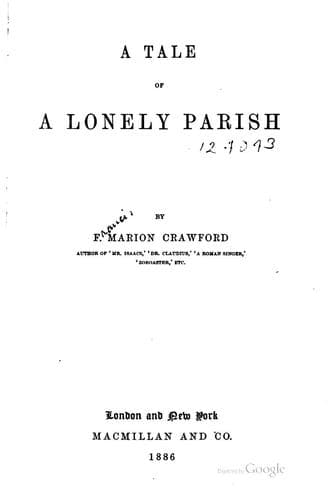
A Tale of a Lonely ParishCrawford, F. Marion (Francis Marion)
General
A Tale of a Lonely Parish
Crawford, F. Marion (Francis Marion)
Country life -- England -- Fiction; England -- Social life and customs -- Fiction
Much depended upon John's obtaining one or more scholarships during his
career at college. To a man of inferior talents the vicar would have
suggested that it would be wiser to go to a smaller college than Trinity
where he would have less competition to expect; but as soon as he
realised John's powers, he made up his mind that it would be precisely
where competition was hottest that his pupil would have the greatest
success. He would get something--perhaps his father would make a little
more money--the vicar even dreamed of lending John a small sum--something
would turn up; at all events he must go to the largest college and do
everything in the best possible way. Meanwhile he must work as hard as he
could during the few months remaining before the beginning of his first
term.
Whether the lady ever wrote to Mr. Ambrose, John could not ascertain; she
was never mentioned at the vicarage, and it seemed as though the mystery
were never to be solved. But the impression she had made upon the young
man's mind remained and even gained strength by the working of his
imagination; for he thought of her night and day, treasuring up every
memory of her that he could recall, building romances in his mind,
conceiving the most ingenious reasons for the solitary visit she had made
to the vicarage, and inwardly vowing that if ever he should be at liberty
to follow his own inclinations he would go out into the world and search
for her. He was only eighteen then, and of a strongly susceptible
temperament. He had seen nothing of the world, for even when living in
London, in a dingy lodging, with his father, he had been perpetually
occupied with books, reading much and seeing little. Then he had been at
school, but he had seen the dark side of school life--the side which boys
who are known to be very poor generally see; and more than ever he had
resorted to study for comfort and relief from outward ills. Then at last
he had been transferred to a serener state in the vicarage of
Billingsfield and had grown up rapidly from a schoolboy to a young man;
but, as has been said, the feminine element at the vicarage was solely
represented by Mrs. Ambrose and the monotony of her maternal society was
varied only by the occasional visits of the mild young Mrs. Edward
Pewlay. John Short had indeed a powerful and aspiring imagination, but it
would have been impossible even by straining that faculty to its utmost
activity to think in the same breath of romance and of Mrs. Ambrose, for
even in her youth Mrs. Ambrose had not been precisely a romantic
character. John's fancy was not stimulated by his surroundings, but it
fed upon itself and grew fast enough to acquire an influence over
everything he did. It was not surprising that, when at last chance threw
in his way a being who seemed instantly to realise and fulfil his wildest
dreams of beauty and feminine fascination, he should have yielded without
a struggle to the delicious influence, feeling that henceforth his ideal
Public-domain text, read in full here on John Shaqi.
Reviews
Reviews
No reviews yet
Be the first to share your thoughts on this work.
Join the Discussion
Join the discussion
Sign in to leave a comment or review.
Sign InorCreate an account