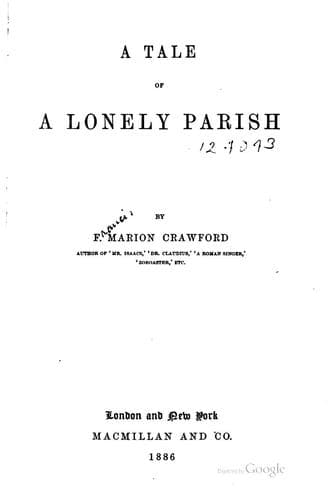
A Tale of a Lonely ParishCrawford, F. Marion (Francis Marion)
General
A Tale of a Lonely Parish
Crawford, F. Marion (Francis Marion)
Country life -- England -- Fiction; England -- Social life and customs -- Fiction
John Short had almost finished his hard work at college. For two years
and a half he had laboured on acquiring for himself reputation and a
certain amount of more solid advantage in the shape of scholarships.
Never in that time had he left Cambridge even for a day unless compelled
to do so by the regulations of his college. His father had found it hard
to induce him to come up to town; and, being in somewhat easier
circumstances since John had declared that he needed no further help to
complete his education, he had himself gone to see his son more than
once. But John had never been to Billingsfield and he knew nothing of the
changes that had taken place there. At last, however, Short felt that he
must have some rest before he went up for honours; he had grown thin and
even pale; his head ached perpetually, and his eyes no longer seemed so
good as they had been. He went to a doctor, and the doctor told him that
with his admirable constitution a few days of absolute rest would do all
that was necessary. John wrote to Mr. Ambrose to say that he would at
last accept the invitation so often extended and would spend the week
between Christmas and New Year's day at Billingsfield.
There were great rejoicings at the vicarage. John had never been
forgotten for a day since he had left, each successive step in his career
had been hailed with hearty delight, and now that at last he was coming
back to rest himself for a week before the final effort Mrs. Ambrose was
as enthusiastic as her husband. Even Mrs. Goddard, who was not quite sure
whether she had ever seen John or not, and the squire who had certainly
never seen him, joined in the general excitement. Mrs. Goddard asked the
entire party to tea at the cottage and the squire asked them to come and
skate at the Hall and to dine afterwards; for the weather was cold and
the vicar said John was a very good skater. Was there anything John could
not do? There was nothing he could not do much better than anybody else,
answered Mr. Ambrose; and the good clergyman's pride in his pupil was
perhaps not the less because he had at first received him on charitable
considerations, and felt that if he had risked much in being so generous
he had also been amply rewarded by the brilliant success of his
undertaking.
When John arrived, everybody said he was "so much improved." He had got
his growth now, being close upon one and twenty years of age; his blue
eyes were deeper set; his downy whiskers had disappeared and a small
moustache shaded his upper lip; he looked more intellectual but not less
strong, though Mrs. Ambrose said he was dreadfully pale--perhaps he owed
some of the improvement observed in his appearance to the clothes he
wore. Poor boy, he had been but scantily supplied in the old days; he
looked prosperous, now, by comparison.
"We have had great additions to our society, since you left us," said the
vicar. "We have got a squire at the Hall, and a lady with a little girl
at the cottage."
Public-domain text, read in full here on John Shaqi.
Reviews
Reviews
No reviews yet
Be the first to share your thoughts on this work.
Join the Discussion
Join the discussion
Sign in to leave a comment or review.
Sign InorCreate an account