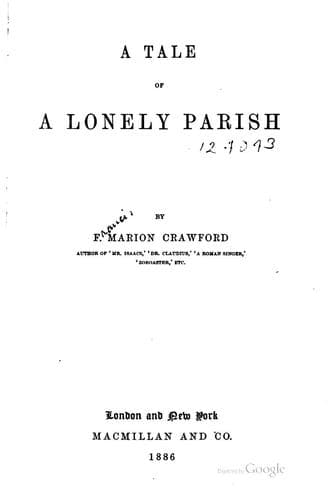
A Tale of a Lonely ParishCrawford, F. Marion (Francis Marion)
General
A Tale of a Lonely Parish
Crawford, F. Marion (Francis Marion)
Country life -- England -- Fiction; England -- Social life and customs -- Fiction
"Such a nice little girl," remarked Mrs. Ambrose.
When John found out that the lady at the cottage was no other than the
lady in black to whom he had lost his heart two years and a half before,
he was considerably surprised. It would be absurd to suppose that the
boyish fancy which had made so much romance in his life for so many
months could outlast the excitements of the University. It would be
absurd to dignify such a fancy by any serious name. He had grown to be a
man since those days and he had put away childish things. He blushed to
remember that he had spent hours in writing odes to the beautiful
unknown, and whole nights in dreaming of her face. And yet he could
remember that as much as a year after he had left Billingsfield he still
thought of her as his highest ideal of woman, and still occasionally
composed a few verses to her memory, regretting, perhaps, the cooling of
his poetic ardour. Then he had gradually lost sight of her in the hard
work which made up his life. Profound study had made him more prosaic and
he believed that he had done with ideals for ever, after the manner of
many clever young fellows who at one and twenty feel that they are
separated from the follies of eighteen by a great and impassable gulf.
The gulf, however, was not in John's case so wide nor so deep but what,
at the prospect of being suddenly brought face to face, and made
acquainted, with her who for so long had seemed the object of a romantic
passion, he felt a strange thrill of surprise and embarrassment. Those
meetings of later years generally bring painful disillusion. How many of
us can remember some fair-haired little girl who in our childhood
represented to us the very incarnation of feminine grace and beauty, for
whom we fetched and carried, for whom we bound nosegays on the heath and
stole apples from the orchard and climbed upon the table after desert, if
we were left alone in the dining-room, to lay hands on some beautiful
sweetmeat wrapped in tinsel and fringes of pink paper--have we not met
her again in after-life, a grown woman, very, very far from our ideal of
feminine grace and beauty? And still in spite of changes in herself and
ourselves there has clung to her memory through all those years enough of
romance to make our heart beat a little faster at the prospect of
suddenly meeting her, enough to make us wonder a little regretfully if
she was at all like the little golden-haired child we loved long ago.
Public-domain text, read in full here on John Shaqi.
Reviews
Reviews
No reviews yet
Be the first to share your thoughts on this work.
Join the Discussion
Join the discussion
Sign in to leave a comment or review.
Sign InorCreate an account