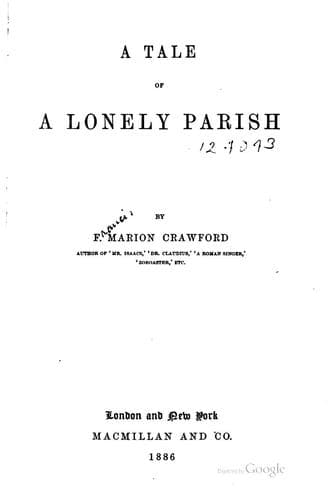
A Tale of a Lonely ParishCrawford, F. Marion (Francis Marion)
General
A Tale of a Lonely Parish
Crawford, F. Marion (Francis Marion)
Country life -- England -- Fiction; England -- Social life and customs -- Fiction
John Short was eighteen years of age, neither particularly good-looking
nor by any means the reverse. He had what bankers commonly call a lucky
face; that is to say he had a certain very prepossessing look of honesty
in his blue eyes, and a certain look of energetic goodwill in his
features. When he was much older and wore a beard he passed for a
handsome man, but at eighteen he could only boast the smallest of fair
whiskers, and when anybody took the trouble to look long at him, which
was not often, the verdict was that his jaw was too heavy and his mouth
too obstinate. In complexion he was fair, and healthy to look at,
generally sunburned in the summer, for he had a habit of reading out of
doors; his laugh was very pleasant, though it was rarely heard; his eyes
were honest but generally thoughtful; his frame was sturdy and already
inclined rather to strength than to graceful proportion; his head matched
his body well, being broad and well-shaped with plenty of prominence over
the brows and plenty of fulness above the temples. He had a way of
standing as though it would not be easy to move him, and a way of
expressing his opinion which seemed to challenge contradiction. But he
was not a combative boy. If any one argued with him, it soon appeared
that he was not really argumentative, but merely enthusiastic. It was not
necessary to agree with him, and there was small use in contradicting
him. The more he talked the more enthusiastic he grew as he developed his
own views; until seeing that he was not understood or that he was merely
laughed at, he would end his discourse with a merry laugh at himself, or
a shy apology for having talked so much. But the vicar assured his wife
that the boy's Greek and Latin verses were something very extraordinary
indeed, and much better than his own in his best days. For John was
passionately fond of the classics and did not propose to acquire any more
mathematical knowledge than was strictly necessary for his matriculation
and "little-go." He meant to be a famous scholar and he meant to get a
fellowship at his college in order to be perfectly independent and to
help his father.
Public-domain text, read in full here on John Shaqi.
Reviews
Reviews
No reviews yet
Be the first to share your thoughts on this work.
Join the Discussion
Join the discussion
Sign in to leave a comment or review.
Sign InorCreate an account