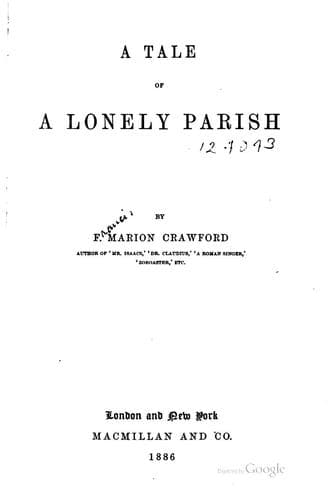
A Tale of a Lonely ParishCrawford, F. Marion (Francis Marion)
General
A Tale of a Lonely Parish
Crawford, F. Marion (Francis Marion)
Country life -- England -- Fiction; England -- Social life and customs -- Fiction
John was a constant source of wonder to his companion the Honourable
Cornelius Angleside, who remembered to have seen fellows of that sort at
Eton but had never got near enough to them to know what they were really
like. Cornelius had a vague idea that there was some trick about
appearing to know so much and that those reading chaps were awful
humbugs. How the trick was performed he did not venture to explain, but
he was as firmly persuaded that it was managed by some species of
conjuring as that Messrs. Maskelyne and Cook performed their wonders by
sleight of hand. That one human brain should actually contain the amount
of knowledge John Short appeared to possess was not credible to the
Honourable Cornelius, and the latter spent more of his time in trying to
discover how John "did it" than in trying to "do it" himself.
Nevertheless, young Angleside liked Short after his own fashion, and
Short did not dislike Angleside. John's father had given him to
understand that as a general rule persons of wealth and good birth were a
set of overbearing, purse-proud bullies, who considered men of genius to
be little better than a set of learned monkeys, certainly not good enough
to black their boots. For John's father in his misfortunes had imbibed
sundry radical notions formerly peculiar to poor literary men, and not
yet altogether extinct, and he had accordingly warned his son that all
mammon was the mammon of unrighteousness, and that the people who
possessed it were the natural enemies of people who had to live by their
brains. But John had very soon discovered that though Cornelius Angleside
possessed the three qualifications for perdition, in the shape of birth,
wealth and ignorance, against which his poor father railed unceasingly,
he succeeded nevertheless in making himself very good company. Angleside
was not overbearing, he was not purse-proud and he was not a bully. On
the contrary he was unobtrusive and sufficiently simple in manner, and he
certainly never mentioned the subject of his family or fortune; John
rather pitied him, on the whole, until he began to discover that
Angleside looked up to him on account of his mental superiority, and then
John, being very human, began to like him.
Public-domain text, read in full here on John Shaqi.
Reviews
Reviews
No reviews yet
Be the first to share your thoughts on this work.
Join the Discussion
Join the discussion
Sign in to leave a comment or review.
Sign InorCreate an account