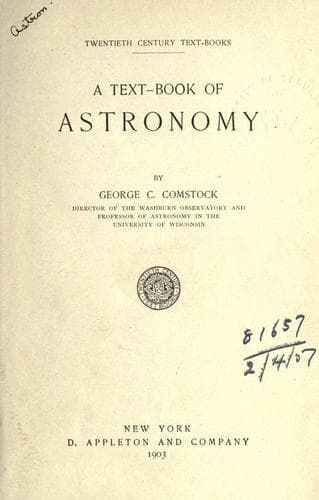
A Text-Book of AstronomyComstock, George C. (George Cary)
Science
A Text-Book of Astronomy
Comstock, George C. (George Cary)
Astronomy
The astronomer who measures with an appropriate instrument the angle
subtended by the moon may in an entirely similar manner find the moon's
diameter and has, in fact, found it to be 2,163 miles. Can the same
method be used to find the diameter of the sun? A planet? The earth?
CHAPTER II
THE STARS AND THEIR DIURNAL MOTION
8. THE STARS.--From the very beginning of his study in astronomy, and as
frequently as possible, the student should practice watching the stars
by night, to become acquainted with the constellations and their
movements. As an introduction to this study he may face toward the
north, and compare the stars which he sees in that part of the sky with
the map of the northern heavens, given on Plate I, opposite page 124.
Turn the map around, upside down if necessary, until the stars upon it
match the brighter ones in the sky. Note how the stars are grouped in
such conspicuous constellations as the Big Dipper (Ursa Major), the
Little Dipper (Ursa Minor), and Cassiopeia. These three constellations
should be learned so that they can be recognized at any time.
_The names of the stars._--Facing the star map is a key which contains
the names of the more important constellations and the names of the
brighter stars in their constellations. These names are for the most
part a Greek letter prefixed to the genitive case of the Latin name of
the constellation. (See the Greek alphabet printed at the end of the
book.)
9. MAGNITUDES OF THE STARS.--Nearly nineteen centuries ago St. Paul
noted that "one star differeth from another star in glory," and no more
apt words can be found to mark the difference of brightness which the
stars present. Even prior to St. Paul's day the ancient Greek
astronomers had divided the stars in respect of brightness into six
groups, which the modern astronomers still use, calling each group a
_magnitude_. Thus a few of the brightest stars are said to be of the
first magnitude, the great mass of faint ones which are just visible to
the unaided eye are said to be of the sixth magnitude, and intermediate
degrees of brilliancy are represented by the intermediate magnitudes,
second, third, fourth, and fifth. The student must not be misled by the
word magnitude. It has no reference to the size of the stars, but only
to their brightness, and on the star maps of this book the larger and
smaller circles by which the stars are represented indicate only the
brightness of the stars according to the system of magnitudes. Following
the indications of these maps, the student should, in learning the
principal stars and constellations, learn also to recognize how bright
is a star of the second, fourth, or other magnitude.
Public-domain text, read in full here on John Shaqi.
Reviews
Reviews
No reviews yet
Be the first to share your thoughts on this work.
Join the Discussion
Join the discussion
Sign in to leave a comment or review.
Sign InorCreate an account