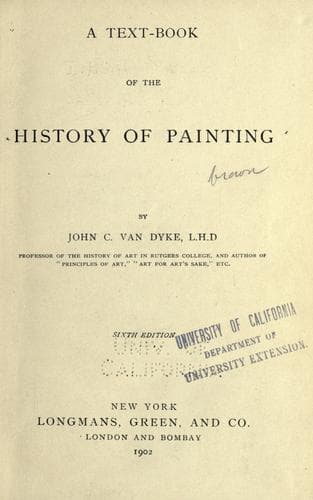
A Text-Book of the History of PaintingVan Dyke, John C.
History
A Text-Book of the History of Painting
Van Dyke, John C.
Painting -- History
A number of excellent _genre_ painters have been claimed by the
impressionists as belonging to their brotherhood. There is little to
warrant the claim, except the adoption to some extent of the modern
ideas of illumination and flat painting. Dagnan-Bouveret (1852-) is
one of these men, a good draughtsman, and a finished clean painter who
by his recent use of high color finds himself occasionally looked upon
as an impressionist. As a matter of fact he is one of the most
conservative of the moderns--a man of feeling and imagination, and a
fine technician. Fantin-Latour (1836-1904) is half romantic, half
allegorical in subject, and in treatment oftentimes designedly vague
and shadowy, more suggestive than realistic. Duez (1843-) and Gervex
(1848-) are perhaps nearer to impressionism in their works than the
others, but they are not at all advance advocates of this latest phase
of art. In addition there are Cottet and Henri Martin.
[Illustration: FIG. 68.--MEISSONIER. NAPOLEON IN 1814.]
THE IMPRESSIONISTS: The name is a misnomer. Every painter is an
impressionist in so far as he records his impressions, and all art is
impressionistic. What Manet (1833-1883), the leader of the original
movement, meant to say was that nature should not be painted as it
actually is, but as it "impresses" the painter. He and his few
followers tried to change the name to Independents, but the original
name has clung to them and been mistakenly fastened to a present band
of landscape painters who are seeking effects of light and air and
should be called luminists if it is necessary for them to be named at
all. Manet was extravagant in method and disposed toward low life for
a subject, which has always militated against his popularity; but he
was a very important man for his technical discoveries regarding the
relations of light and shadow, the flat appearance of nature, the
exact value of color tones. Some of his works, like The Boy with a
Sword and The Toreador Dead, are excellent pieces of painting. The
higher imaginative qualities of art Manet made no great effort at
attaining.
Degas stands quite by himself, strong in effects of motion, especially
with race-horses, fine in color, and a delightful brushman in such
subjects as ballet-girls and scenes from the theatre. Besnard is one
of the best of the present men. He deals with the figure, and is
usually concerned with the problem of harmonizing color under
conflicting lights, such as twilight and lamplight. Beraud and
Raffaelli are exceedingly clever in street scenes and character
pieces; Pissarro[16] handles the peasantry in high color; Brown
(1829-1890), the race-horse, and Renoir, the middle class of social
life. Caillebotte, Roll, Forain, and Miss Cassatt, an American, are
also classed with the impressionists.
[Footnote 16: Died, 1903.]
Public-domain text, read in full here on John Shaqi.
Reviews
Reviews
No reviews yet
Be the first to share your thoughts on this work.
Elsewhere in the archive
Join the Discussion
Join the discussion
Sign in to leave a comment or review.
Sign InorCreate an account