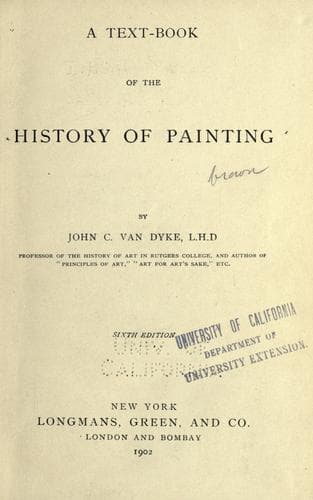
A Text-Book of the History of PaintingVan Dyke, John C.
History
A Text-Book of the History of Painting
Van Dyke, John C.
Painting -- History
The pure Spanish school in Andalusia, as distinct from Italian
imitation, may be said to have started with Herrera. It was further
advanced by another independent painter, Zurbaran (1598-1662), a pupil
of Roelas. He was a painter of the emaciated monk in ecstasy, and many
other rather dismal religious subjects expressive of tortured rapture.
From using a rather dark shadow he acquired the name of the Spanish
Caravaggio. He had a good deal of Caravaggio's strength, together with
a depth and breadth of color suggestive of the Venetians. Cano
(1601-1667), though he never was in Italy, had the name of the Spanish
Michael Angelo, probably because he was sculptor, painter, and
architect. His painting was rather sharp in line and statuesque in
pose, with a coloring somewhat like that of Van Dyck. It was eclectic
rather than original work.
[Illustration: FIG. 72.--FORTUNY. SPANISH MARRIAGE.]
Murillo (1618-1682) is generally placed at the head of the Andalusian
school, as Velasquez at the head of the Castilian. There is good
reason for it, for though Murillo was not the great painter he was
sometime supposed, yet he was not the weak man his modern critics
would make him out. A religious painter largely, though doing some
_genre_ subjects like his beggar-boy groups, he sought for religious
fervor and found, only too often, sentimentality. His madonnas are
usually after the Carlo Dolci pattern, though never so excessive in
sentiment. This was not the case with his earlier works, mostly of
humble life, which were painted in rather a hard, positive manner.
Later on he became misty, veiled in light and effeminate in outline,
though still holding grace. His color varied with his early and later
styles. It was usually gay and a little thin. While basing his work on
nature like Velasquez, he never had the supreme poise of that master,
either mentally or technically; howbeit he was an excellent painter,
who perhaps justly holds second place in Spanish art.
Public-domain text, read in full here on John Shaqi.
Reviews
Reviews
No reviews yet
Be the first to share your thoughts on this work.
Elsewhere in the archive
Join the Discussion
Join the discussion
Sign in to leave a comment or review.
Sign InorCreate an account