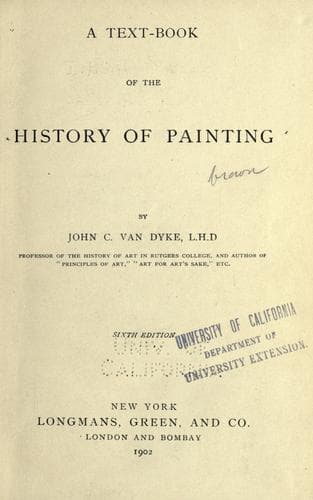
A Text-Book of the History of PaintingVan Dyke, John C.
History
A Text-Book of the History of Painting
Van Dyke, John C.
Painting -- History
Hans Holbein the Younger (1497-1543) holds, with Duerer, the high place
in German art. He was a more mature painter than Duerer, coming as he
did a quarter of a century later. He was the Renaissance artist of
Germany, whereas Duerer always had a little of the Gothic clinging to
him. The two men were widely different in their points of view and in
their work. Duerer was an idealist seeking after a type, a religious
painter, a painter of panels with the spirit of an engraver. Holbein
was emphatically a realist finding material in the actual life about
him, a designer of cartoons and large wall paintings in something of
the Italian spirit, a man who painted religious themes but with little
spiritual significance.
It is probable that he got his first instruction from his father and
from Burkmair. He was an infant prodigy, developed early, saw much
foreign art, and showed a number of tendencies in his work. In
composition and drawing he appeared at times to be following Mantegna
and the northern Italians; in brush-work he resembled the Flemings,
especially Massys; yet he was never an imitator of either Italian or
Flemish painting. Decidedly a self-sufficient and an observing man, he
travelled in Italy and the Netherlands, and spent much of his life in
England, where he met with great success at court as a portrait-painter.
From seeing much he assimilated much, yet always remained German,
changing his style but little as he grew older. His wall paintings have
perished, but the drawings from them are preserved and show him as an
artist of much invention. He is now known chiefly by his portraits, of
which there are many of great excellence. His facility in grasping
physiognomy and realizing character, the quiet dignity of his
composition, his firm modelling, clear outline, harmonious coloring,
excellent detail, and easy solid painting, all place him in the front
rank of great painters. That he was not always bound down to literal
facts may be seen in his many designs for wood-engravings. His portrait
of Hubert Morett, in the Dresden Gallery, shows his art to advantage,
and there are many portraits by him of great spirit in England, in the
Louvre, and elsewhere.
Public-domain text, read in full here on John Shaqi.
Reviews
Reviews
No reviews yet
Be the first to share your thoughts on this work.
Elsewhere in the archive
Join the Discussion
Join the discussion
Sign in to leave a comment or review.
Sign InorCreate an account