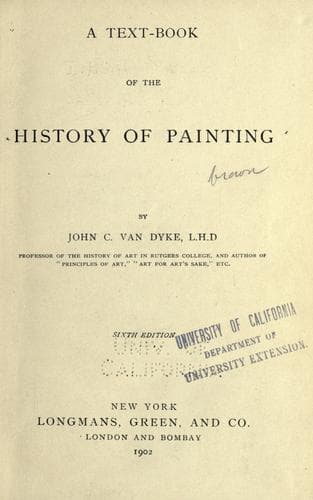
A Text-Book of the History of PaintingVan Dyke, John C.
History
A Text-Book of the History of Painting
Van Dyke, John C.
Painting -- History
SAXON SCHOOL: Lucas Cranach (1472-1553) was a Franconian master, who
settled in Saxony and was successively court-painter to three Electors
and the leader of a small local school there. He, perhaps, studied
under Gruenewald, but was so positive a character that he showed no
strong school influence. His work was fantastic, odd in conception and
execution, sometimes ludicrous, and always archaic-looking. His type
was rather strained in proportions, not always well drawn, but
graceful even when not truthful. This type was carried into all his
works, and finally became a mannerism with him. In subject he was
religious, mythological, romantic, pastoral, with a preference for
the nude figure. In coloring he was at first golden, then brown, and
finally cold and sombre. The lack of aerial perspective and shadow
masses gave his work a queer look, and he was never much of a
brushman. His pictures were typical of the time and country, and for
that and for their strong individuality they are ranked among the most
interesting paintings of the German school. Perhaps his most
satisfactory works are his portraits. Lucas Cranach the Younger
(1515-1586) was the best of the elder Cranach's pupils. Many of his
pictures are attributed to his father. He followed the elder closely,
but was a weaker man, with a smoother brush and a more rosy color.
Though there were many pupils the school did not go beyond the Cranach
family. It began with the father and died with the son.
[Illustration: FIG. 92.--LEIBL. IN CHURCH.]
SEVENTEENTH AND EIGHTEENTH CENTURIES: These were unrelieved centuries
of decline in German painting. After Duerer, Holbein, and Cranach had
passed there came about a senseless imitation of Italy, combined with
an equally senseless imitation of detail in nature that produced
nothing worthy of the name of original or genuine art. It is not
probable that the Reformation had any more to do with this than with
the decline in Italy. It was a period of barrenness in both countries.
The Italian imitators in Germany were chiefly Rottenhammer
(1564-1623), and Elzheimer (1574?-1620). After them came the
representative of the other extreme in Denner (1685-1749), who thought
to be great in portraiture by the minute imitation of hair, freckles,
and three-days'-old beard--a petty and unworthy realism which excited
some curiosity but never held rank as art. Mengs (1728-1779) sought
for the sublime through eclecticism, but never reached it. His work,
though academic and correct, is lacking in spirit and originality.
Angelica Kauffman (1741-1807) succeeded in pleasing her inartistic age
with the simply pretty, while Carstens (1754-1798) was a conscientious
if mistaken student of the great Italians--a man of some severity in
form and of academic inclinations.
Public-domain text, read in full here on John Shaqi.
Reviews
Reviews
No reviews yet
Be the first to share your thoughts on this work.
Elsewhere in the archive
Join the Discussion
Join the discussion
Sign in to leave a comment or review.
Sign InorCreate an account