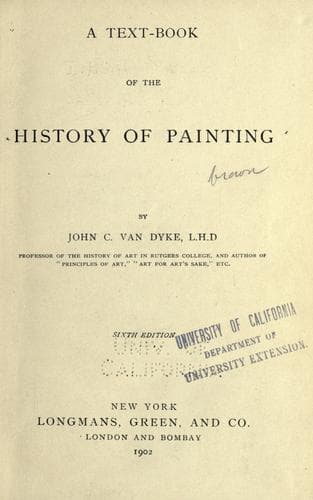
A Text-Book of the History of PaintingVan Dyke, John C.
History
A Text-Book of the History of Painting
Van Dyke, John C.
Painting -- History
BOOKS RECOMMENDED: As before, Burckhardt, Crowe and
Cavalcaselle, Eastlake, Lafenestre, Lanzi, Lindsay, Reber;
also Burton, _Catalogue of Pictures in the National Gallery,
London_ (_unabridged edition_); Cartier, _Vie de Fra
Angelico_; Foerster, _Leben und Werke des Fra Angelico_;
Habich, _Vade Mecum pour la Peinture Italienne des Anciens
Maitres_; Lacroix, _Les Arts au Moyen-Age et a la Epoque de
la Renaissance_; Mantz, _Les Chefs-d'oeuvre de la Peinture
Italienne_; Morelli, _Italian Masters in German Galleries_;
Morelli, _Italian Masters, Critical Studies in their Works_;
Rumohr, _Italienische Forschungen_; Selincourt, _Giotto_;
Stillman, _Old Italian Masters_; Vasari, _Lives of the Most
Eminent Painters_; consult also General Bibliography (p.
xv).
SIGNS OF THE AWAKENING: It would seem at first as though nothing but
self-destruction could come to that struggling, praying,
throat-cutting population that terrorized Italy during the Mediaeval
Period. The people were ignorant, the rulers treacherous, the passions
strong, and yet out of the Dark Ages came light. In the thirteenth
century the light grew brighter, but the internal dissensions did not
cease. The Hohenstaufen power was broken, the imperial rule in Italy
was crushed. Pope and emperor no longer warred each other, but the
cries of "Guelf" and "Ghibelline" had not died out.
Throughout the entire Romanesque and Gothic periods (1000-1400) Italy
was torn by political wars, though the free cities, through their
leagues of protection and their commerce, were prosperous. A
commercial rivalry sprang up among the cities. Trade with the East,
manufactures, banking, all flourished; and even the philosophies, with
law, science, and literature, began to be studied. The spirit of
learning showed itself in the founding of schools and universities.
Dante, Petrarch, and Boccaccio, reflecting respectively religion,
classic learning, and the inclination toward nature, lived and gave
indication of the trend of thought. Finally the arts, architecture,
sculpture, painting, began to stir and take upon themselves new
appearances.
SUBJECTS AND METHODS: In painting, though there were some portraits
and allegorical scenes produced during the Gothic period, the chief
theme was Bible story. The Church was the patron, and art was only the
servant, as it had been from the beginning. It was the instructor and
consoler of the faithful, a means whereby the Church made converts,
and an adornment of wall and altar. It had not entirely escaped from
symbolism. It was still the portrayal of things for what they meant,
rather than for what they looked. There was no such thing then as art
for art's sake. It was art for religion's sake.
Public-domain text, read in full here on John Shaqi.
Reviews
Reviews
No reviews yet
Be the first to share your thoughts on this work.
Join the Discussion
Join the discussion
Sign in to leave a comment or review.
Sign InorCreate an account