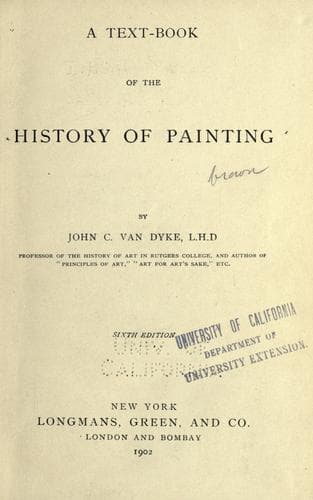
A Text-Book of the History of Painting — John Shaqi
A Text-Book of the History of PaintingVan Dyke, John C.
History
A Text-Book of the History of Painting
Van Dyke, John C.
Painting -- History
The demand for painting increased, and its subjects multiplied with
the establishment at this time of the two powerful orders of Dominican
and Franciscan monks. The first exacted from the painters more learned
and instructive work; the second wished for the crucifixions, the
martyrdoms, the dramatic deaths, wherewith to move people by emotional
appeal. To offset this the ultra-religious character of painting was
encroached upon somewhat by the growth of the painters' guilds, and
art production largely passing into the hands of laymen. In
consequence painting produced many themes, but, as yet, only after the
Byzantine style. The painter was more of a workman than an artist. The
Church had more use for his fingers than for his creative ability. It
was his business to transcribe what had gone before. This he did, but
not without signs here and there of uneasiness and discontent with the
pattern. There was an inclination toward something truer to nature,
but, as yet, no great realization of it. The study of nature came in
very slowly, and painting was not positive in statement until the time
of Giotto and Lorenzetti.
[Illustration: FIG. 22.--GIOTTO, FLIGHT INTO EGYPT. ARENA CHAP.
PADUA.]
The best paintings during the Gothic period were executed upon the
walls of the churches in fresco. The prepared color was laid on wet
plaster, and allowed to soak in. The small altar and panel pictures
were painted in distemper, the gold ground and many Byzantine features
being retained by most of the painters, though discarded by some few.
CHANGES IN THE TYPE, ETC.: The advance of Italian art in the Gothic
age was an advance through the development of the imposed Byzantine
pattern. It was not a revolt or a starting out anew on a wholly
original path. When people began to stir intellectually the artists
found that the old Byzantine model did not look like nature. They
began, not by rejecting it, but by improving it, giving it slight
movements here and there, turning the head, throwing out a hand, or
shifting the folds of drapery. The Eastern type was still seen in the
long pathetic face, oblique eyes, green flesh tints, stiff robes, thin
fingers, and absence of feet; but the painters now began to modify and
enliven it. More realistic Italian faces were introduced,
architectural and landscape backgrounds encroached upon the Byzantine
gold grounds, even portraiture was taken up.
This looks very much like realism, but we must not lay too much stress
upon it. The painters were taking notes of natural appearances. It
showed in features like the hands, feet, and drapery; but the anatomy
of the body had not yet been studied, and there is no reason to
believe their study of the face was more than casual, nor their
portraits more than records from memory.
Public-domain text, read in full here on John Shaqi.
Reviews
Reviews
No reviews yet
Be the first to share your thoughts on this work.
Join the Discussion
Join the discussion
Sign in to leave a comment or review.
Sign InorCreate an account