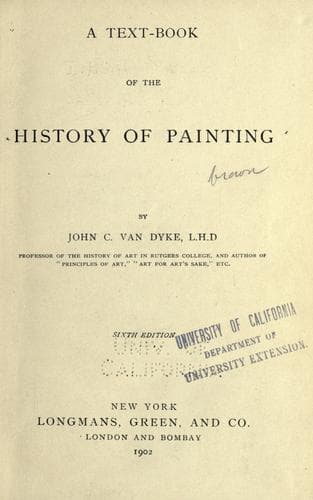
A Text-Book of the History of PaintingVan Dyke, John C.
History
A Text-Book of the History of Painting
Van Dyke, John C.
Painting -- History
UMBRIAN AND PERUGIAN SCHOOLS: At the beginning of the fifteenth
century the old Siennese school founded by Duccio and the Lorenzetti
was in a state of decline. It had been remarkable for intense
sentiment, and just what effect this sentiment of the old Siennese
school had upon the painters of the neighboring Umbrian school of the
early fifteenth century is a matter of speculation with historians. It
must have had some, though the early painters, like Ottaviano Nelli,
do not show it. That which afterward became known as the Umbrian
sentiment probably first appeared in the work of Niccolo da Foligno
(1430?-1502), who was probably a pupil of Benozzo Gozzoli, who was, in
turn, a pupil of Fra Angelico. That would indicate Florentine
influence, but there were many influences at work in this upper-valley
country. Sentiment had been prevalent enough all through Central
Italian painting during the Gothic age--more so at Sienna than
elsewhere. With the Renaissance Florence rather forsook sentiment for
precision of forms and equilibrium of groups; but the Umbrian towns
being more provincial, held fast to their sentiment, their detail, and
their gold ornamentation. Their influence upon Florence was slight,
but the influence of Florence upon them was considerable. The larger
city drew the provincials its way to learn the new methods. The
result was a group of Umbro-Florentine painters, combining some
up-country sentiment with Florentine technic. Gentile da Fabriano,
Niccolo da Foligno, Bonfiglio (1425?-1496?), and Fiorenzo di Lorenzo
(1444?-1520) were of this mixed character.
[Illustration: FIG. 30.--SIGNORELLI. THE CURSE (DETAIL). ORVIETO.]
The most positive in methods among the early men was Piero della
Francesca (1420?-1492). Umbrian born, but Florentine trained, he
became more scientific than sentimental, and excelled as a craftsman.
He knew drawing, perspective, atmosphere, light-and-shade in a way
that rather foreshadowed Leonardo da Vinci. From working in the
Umbrian country his influence upon his fellow-Umbrians was large. It
showed directly in Signorelli (1441?-1523), whose master he was, and
whose style he probably formed. Signorelli was Umbrian born, like
Piero, but there was not much of the Umbrian sentiment about him. He
was a draughtsman and threw his strength in line, producing athletic,
square-shouldered figures in violent action, with complicated
foreshortenings quite astonishing. The most daring man of his time, he
was a master in anatomy, composition, motion. There was nothing select
about his type, and nothing charming about his painting. His color was
hot and coarse, his lights lurid, his shadows brick red. He was,
however, a master-draughtsman, and a man of large conceptions and
great strength. Melozzo da Forli (1438-1494), of whom little is known,
was another pupil of Piero, and Giovanni Santi (1435?-1494), the
father of Raphael, was probably influenced by both of these last
named.
Public-domain text, read in full here on John Shaqi.
Reviews
Reviews
No reviews yet
Be the first to share your thoughts on this work.
Join the Discussion
Join the discussion
Sign in to leave a comment or review.
Sign InorCreate an account